PART 1
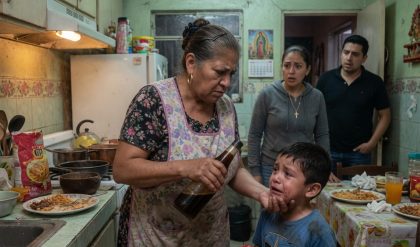
They tore her son from her arms in front of the whole family, telling her that this child was nothing but a lie.
Camille stood frozen in the middle of the living room of the Delaroche mansion in Neuilly-sur-Seine, her coat still soaking wet from the rain and her 2-year-old little boy crying against her shoulder. Around her, no one moved. The cousins, the uncles, her husband’s sister, all sat as if in a courtroom. The champagne glasses set on the coffee table hadn’t even been touched.
Julien stood near the fireplace, pale, a folded paper in his hand. His mother, Éléonore Delaroche, upright in her ivory suit, looked at her with that cruel calm she reserved for servants and women she deemed unworthy of her name.
— Read it, Julien said.
Camille took the paper. Her fingers slipped on the page. At the top, the logo of a Parisian laboratory. Then the words that took her breath away.
Paternity test. Probability of paternity: 0%.
The living room spun around her. She looked at her son, Mathis, with his chestnut curls, his eyelids swollen with sleep, his little hand gripping her scarf.
— It’s impossible, she whispered. Julien, look at me. It’s a lie.
Julien’s sister, Solène, sneered.
— All women caught red-handed say that.
Camille raised her head, struck as if by a slap.
— You had my son tested behind my back?
Julien didn’t answer right away. His eyes were red, but there was no tenderness. Only a coldness that hurt her more than shouting.
— You were coming home late. You were hiding your phone. Mother told me I had to stop being naive.
— I was preparing your birthday, Julien. With your brother. You would have known if you had talked to me instead of spying on me.
Éléonore stepped forward.
— This boy is not a Delaroche. He will not carry our name, nor our heritage, nor our shame.
Camille squeezed Mathis so hard he whimpered.
— He is your grandson.
— No, answered Éléonore. He is the living proof of your betrayal.
Camille looked for Julien’s gaze. The man who had cried at the maternity ward, the man who had pressed his forehead against hers when Mathis was born, remained motionless. He was letting her drown in front of his family.
— Say something, she begged.
He lowered his eyes.
— Leave tonight.
The sentence fell without violence, but it opened an abyss. Camille felt something silently break in her chest. She wiped her tears with the back of her hand, picked up Mathis’s bag, and walked towards the entrance.
Just as she put her hand on the doorknob, the door burst open. A man in a dark suit entered, breathless, clutching a briefcase. He looked at the paper in Camille’s hand, then at Julien’s face.
— I am Doctor Armand Caron, director of the laboratory, he said in a strained voice. This result should never have reached your home.
Éléonore went suddenly pale.
And Camille understood that the nightmare had only just begun.
PART 2
Doctor Caron opened his briefcase on the coffee table. He took out 2 sealed files, his hands trembling.
— The sample was falsified. The corrected result indicates 99.9997% paternity.
Camille read the sentence 3 times before letting out a sob. Julien stepped forward, but she stepped back.
— Don’t touch me.
Caron then put down some bank statements.
— The falsification was paid for from an account linked to the Delaroche foundation.
All eyes turned to Éléonore. She didn’t deny it.
— I protected my son, she said. This woman trapped him with a child.
Julien exploded.
— You destroyed my family!
— I saved it.
Caron grew even paler.
— That’s not all. Mathis’s birth file at the Saint-Claire clinic was also altered.
A heavy silence fell.
That night, Caron called Camille in secret. He arranged to meet her near the banks of the Seine. When she arrived, he was lying against a wall, injured, his phone broken beside him.
Before losing consciousness, he grabbed her wrist.
— Saint-Claire… Julien knows… but not everything.
Then Camille heard footsteps behind her.
PART 3
Camille spun around so fast her heel slipped on the wet cobblestones. A man in a black raincoat emerged from the shadow of an archway, his face half-hidden by a hood. He wasn’t running. He advanced with a steady slowness, like someone who already knew that no one would arrive in time.
— Step away from him, Madame Delaroche.
She felt her blood run cold. Behind her, Doctor Caron was breathing with difficulty. A dark stain was spreading on his shirt, but his eyes remained open, pleading.
Camille took out her phone.
— I’m calling the police.
The man raised his hand.
— Do it, and your son disappears before dawn.
The world drained of its noise. Even the rain seemed to stop. Camille thought of Mathis, asleep at the hotel with the nanny, his stuffed rabbit clutched tight. She felt a primal fear rise in her throat, a mother’s fear, the kind that turns the body into a weapon or a tomb.
— Who are you?
— Someone who fixes the mistakes of families like yours.
— Mathis is not a mistake.
The man let out a short, joyless laugh.
— Ask your husband why his name appears in the Saint-Claire file.
At that moment, headlights swept across the quay. A car emerged at the end of the street. The man swore under his breath and retreated into the darkness. The car braked sharply. Julien got out, coatless, drenched, his face devastated.
— Camille!
She felt no relief. Only a cold anger.
— You knew.
He stopped 3 meters from her.
— Not like this.
— He just threatened our son. So you’re going to talk. Now.
Help arrived 6 minutes later. Doctor Caron was taken away alive, between 2 paramedics, but before the doors closed, he managed to whisper:
— The notebook… in my safe… your mother’s maiden name…
Julien closed his eyes, as if those words had just finished him off.
At the 16th arrondissement police station, Camille refused to sit next to him. She remained standing, arms crossed, her gaze hard, while a police commander noted every detail. Julien asked to speak to her alone. She only agreed because the word Saint-Claire was beating in her head like an alarm.
In a white corridor, under lighting that was too harsh, Julien rubbed his hands over his face.
— Before you, I worked 8 months at the Saint-Claire clinic as an intern. I was young. I was 27. My mother funded a maternity wing there. Everyone owed her something.
— Go on.
He swallowed hard.
— One night, there was a fire in the archives. Small, contained, officially accidental. But that same night, 3 birth files disappeared. I found out later.
Camille felt her legs go weak.
— What does that have to do with Mathis?
— When you gave birth, I recognized a nurse. She was already working at Saint-Claire back then. She saw me, she panicked. The next day, she left an envelope in my car.
— And you didn’t tell me anything?
— In the envelope, there was an incomplete copy of Mathis’s birth registry. With an anomaly.
Camille stood very still.
— What anomaly?
Julien lowered his voice.
— Your name was correct. Mine too. But there was a handwritten note: “monitor Valmont protocol”.
— Valmont?
— My mother’s maiden name.
The corridor seemed to shrink around them.
— Your mother had my delivery monitored?
— I confronted her. She swore to me it was an administrative error. She cried. For the 1st time in my life, I saw her beg. She told me that if I spoke up, she would be falsely accused, that the press would destroy our family, that you would be dragged into it when you had just given birth. I was afraid.
Camille looked at him the way you look at a stranger.
— No. You weren’t afraid for me. You were afraid of your mother.
He didn’t answer.
That truth hung between them, naked and ugly.
In the following days, the facade of the Delaroches began to crack. The police searched the family foundation, Éléonore’s office, then an old estate near Versailles where she kept private archives. Camille, meanwhile, lived in a hotel room with Mathis, sleeping in 20-minute intervals, checking the lock 10 times a night. Julien sometimes came to the lobby, without coming up. He left bags of clothes, toys, meals. She didn’t thank him.
One evening, he knelt in front of Mathis in the lobby. The little boy hesitated, then held out his stuffed toy to his father.
— Daddy sad?
Julien burst into tears in front of the hotel guests.
Camille looked away, not out of cruelty, but because her own pain threatened to break. She still loved the man he had been. She hated the one who had left her alone in the middle of the living room, accused like a thief.
Doctor Caron survived. 4 days after the attack, he agreed to speak from his hospital bed. Camille went there with her lawyer. Julien was there too, keeping his distance, his back against the wall.
Caron’s face was gaunt, his voice raspy.
— Your mother-in-law didn’t just fake the DNA test, he said. She used that test to make you leave before other evidence surfaced.
— What evidence? asked Camille.
He closed his eyes.
— At Saint-Claire, 3 years ago, an internal audit revealed trafficking of medical information surrounding certain births. Influential families paid to hide parentage, expedite private adoptions, erase inconvenient pregnancies. The Delaroche foundation helped fund the clinic. Your son was not switched. He is indeed the son of both of you. But his birth triggered an alert because your file bore an old code.
Camille frowned.
— Why my file?
Caron struggled to open a small notebook provided by the police. It contained names, dates, initials. Then he pointed to a line.
Claire Morel. 1995. Saint-Claire. Underage mother. Child given up.
Camille felt her heart stop. Claire Morel was her mother.
— No…
Julien took a step, but she raised her hand to stop him.
Caron continued:
— Your mother gave birth at 17 in that clinic, under pressure from her family. The baby was supposed to be declared stillborn. In reality, it was given to a family close to the Delaroche network.
Camille put her hand to her mouth.
— What baby?
The door opened softly. A woman walked in, accompanied by a police officer. She was barely 30, with the same cheekbones as Camille, the same line of eyebrows, the same tremble in her lip when she tried not to cry.
— Her name is Anaïs, the commander said. She grew up under an altered identity.
Anaïs stared at Camille with a painful shyness.
— I didn’t know I had a sister.
The word hit Camille right in the gut. Sister. All her life, she had believed she was an only child. Her mother, dead for 6 years, had taken this secret to the grave, perhaps out of shame, perhaps out of fear, perhaps because even the right to tell the story of her own trauma had been stolen from her.
Julien collapsed into a chair.
— My mother knew…
Caron nodded slowly.
— When Camille joined the Delaroche family, Éléonore recognized her name. She realized that if anyone dug into her past, the old Saint-Claire network could be exposed. Mathis’s birth reopened the file. She wanted to break Camille before she started asking the right questions.
Camille left the room without a word. She walked to the service stairwell, locked herself in, and vomited into a metal trash can. Anaïs followed her, but kept her distance.
— I can leave, if it’s too much.
Camille looked up. This stranger was mourning a life she had never been given. She wasn’t a threat. She was another victim.
— No, said Camille in a broken voice. Don’t leave.
They sat on the steps, side by side, not knowing how to bridge 30 years of theft. Anaïs told her about group homes, a cold adoption in Lyon, documents found after her adoptive parents died. Camille spoke of her mother, of her silences during certain songs, of the way she cried every October 14th without ever saying why.
The trial of Éléonore Delaroche was not swift. Rich families know how to slow down justice with lawyers, procedures, well-dressed silences. But this time, the truth had too many witnesses. The laboratory technician confessed. The accounts were traced. The man from the riverbank was arrested in Marseille with cash and messages from a foundation middleman. Former Saint-Claire nurses finally spoke, some out of remorse, others because they realized the dead were no longer asking permission.
On the day of the hearing, Camille entered the Paris judicial court holding Mathis by the hand. Anaïs walked on her left. Julien stayed a few steps behind. He hadn’t asked to come back. He had only asked for the right to be present when the truth was spoken.
Éléonore appeared in her dark suit, thinner, even harder. When she saw Mathis, she looked away. Not out of shame. Out of rage.
At the stand, she tried to present herself as a mother who had wanted to protect her son.
Camille asked to speak.
The judge agreed.
She stood up. Her hands shook, but her voice did not break.
— You didn’t protect me. You didn’t protect him. You looked at a 2-year-old child and you decided he was an obstacle. You used a son’s love against his wife. You used a young mother’s shame against her daughter. You took entire lives and you filed them away in folders.
Éléonore stared at her.
— You should never have entered this family.
Camille felt Julien stiffen behind her.
But this time, she no longer needed him to speak for her.
— No, Madame Delaroche. It’s your secret that should never have survived the truth.
The silence that followed was immense.
Éléonore was sentenced to prison, a heavy fine, and a ban from managing any associative or medical organization. The Delaroche foundation was dissolved. Several former Saint-Claire officials were indicted. No verdict gave Anaïs back her childhood, nor Camille’s mother her peace, nor Mathis the nights his mother had trembled while checking the windows. But something had shifted: the name Delaroche was no longer feared.
Julien sold the house in Neuilly. He donated a large portion of the money to a fund for the victims of Saint-Claire, then moved into a small apartment near Parc Monceau to stay close to his son. For months, Camille refused to have dinner with him. She only accepted Sunday walks, at 10 a.m., with Mathis between them.
One winter morning, Mathis ran toward the ducks in the pond, shouting. Julien stood near Camille, his hands in his pockets.
— I won’t ask you to forgive me today, he said.
— Good.
He nodded.
— I just want you to know that I am no longer afraid of her.
Camille watched their son laughing at the water’s edge. The wind lifted his curls.
— The problem, Julien, is not just that you were afraid of her. It’s that you left me alone when I needed you to believe me.
He lowered his eyes.
— I know.
This time, his silence wasn’t looking for an excuse. He accepted the blame. It was a small thing. But it was the 1st honest gesture in a long time.
Camille didn’t go back to living with him. Not that year. Perhaps never. But she stopped hating his face when Mathis jumped into his arms. Anaïs became a gentle, clumsy, indispensable presence. She came on Thursday evenings, brought overcooked tarts, learned how to be an aunt, learned above all how to be a sister.
The following October 14th, Camille, Anaïs, and Mathis went to lay flowers on Claire Morel’s grave. Mathis placed his stuffed toy on the stone, looking very serious.
— For Grandma?
Camille smiled through her tears.
— Yes, sweetheart. For Grandma.
Anaïs slipped her hand into hers. Two daughters of the same mother, separated by a lie, united by a child they had wanted to erase before he even understood the world.
In the distance, Julien waited near the gate, without imposing.
Camille watched her son run between the cemetery paths, alive, loud, free. For a long time, she had believed that the truth destroyed families. That day, she understood that it only destroyed the prisons built around them.
And when Mathis came running back to snuggle against her, she held him tightly without fear, like a mother who had lost everything except what mattered most: the right to hold her child in the light, in front of everyone, without anyone ever again being able to tell her that he wasn’t hers.