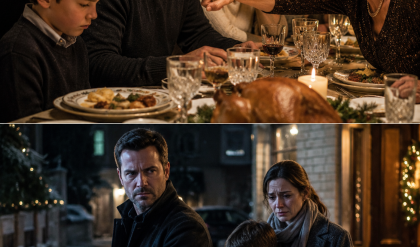
Could she afford thread or groceries? Rent or fabric? Pride or survival?
She had sewn until her fingers bled in a fourth-floor walk-up in Queens after the divorce. She had taken private alteration jobs for women who left dresses on her doorstep because they did not want to be seen entering her building. She had worked anonymously for costume departments, bridal shops, and eventually a luxury atelier that stole three of her designs before firing her for “attitude” when she complained. She had cried exactly twice. Once when the lights were shut off. Once when her sewing machine broke.
After that, she stopped wasting water
The world believed Maya Bennett disappeared after Garrett Cole.
In truth, she had gone underground and built a weapon out of taste.
Valorian House began with one dress made for an actress who could not afford Dior but wanted to look like revenge at a film festival. Photos spread. No one knew the designer’s real identity. Maya used the name Valorian because she liked that it sounded old enough to frighten people who worshiped legacy. She refused interviews. She refused investors. She accepted only clients who understood discretion and paid in advance.
Within three years, Valorian gowns appeared on red carpets without explanation. A senator’s daughter wore one to a state dinner. A country singer wore one to the Grammys and refused to name the designer. A tech billionaire’s wife offered two million dollars for a private consultation and received a polite no. The mystery became part of the brand. Who was Valorian? A retired Parisian master? A secret collective? A reclusive heiress?
Maya let them wonder.
Wonder made people hungry.
Now, on the morning Caroline Whitaker expected her to arrive as a punchline, Maya stood barefoot in her dressing room while her assistant, Jonah Reed, checked the final schedule on a tablet.
“The Sterling car service confirmed twice,” Jonah said. “They think they’re picking you up from a rented address in Queens.”
Maya smiled faintly. “Good.”
“The press list is ugly. Page Six, Manhattan Mirror, LuxeLine Daily, three TikTok fashion vultures, and at least two business reporters pretending they care about the foundation.”
“Also good.”
Jonah looked up. He had been with her since the second year of Valorian, when he was twenty-two and she found him crying behind a garment rack after a designer called him replaceable. He was sharp, loyal, and dramatic enough to make bad news sound like theater. “Maya, forgive me, but most people avoid public ambushes.”
“Most people don’t get invited to their own funeral while still alive.”
“That is exactly the kind of sentence that makes me worry you’re about to do something legendary and emotionally unhealthy.”
She turned from the window. “I’m not going there for revenge.”
Jonah raised one eyebrow.
“I mean it,” she said.
“I believe you believe it.”
Maya walked to the center of the dressing room where the gown waited on a custom form beneath a veil of protective silk. Midnight-blue. Architectural. Hand-beaded by twelve artisans over nine months. The dress had been commissioned by an anonymous collector for the Met Gala and then bought back by Maya personally when she decided it belonged to a different night. It was worth one million dollars on paper, but that number amused her. Men like Garrett understood price before they understood value.
Tonight, he would understand the difference.
“I’m going because Caroline built a stage,” Maya said, touching the edge of the silk veil. “It would be rude not to use it.”
Jonah’s smile arrived slowly. “There she is.”
By noon, Garrett’s mother called him.
Eleanor Cole never raised her voice. She had spent seventy-one years proving volume was unnecessary when disappointment could do the work. Her family had been rich before income tax had teeth, and she wore pearls the way other women wore armor.
“Why is Maya Bennett on my gala guest list?” she asked.
Garrett stood in his office, staring at Central Park through glass. “Ask Caroline.”
“I am asking my son.”
He closed his eyes briefly. “It was a mistake.”
“No,” Eleanor said. “A mistake is a misspelled name card. This is strategy. Whose?”
“Mother.”
“Do not mother me when your mistress has decided to turn my foundation into a carnival.”
The word mistress landed with deliberate force. Garrett had never liked it, though he had done nothing to prevent it from being accurate.
“Caroline thinks Maya won’t come,” he said.
Eleanor was silent for a moment. “And what do you think?”
He did not answer quickly enough.
His mother sighed, and for the first time her voice softened. “Garrett, there are women who collapse when humiliated, and there are women who disappear long enough to return with better weapons. Maya was never the first kind.”
“You haven’t spoken to her in years.”
“No. But unlike you, I listened when she spoke.”
That cut deeper than he expected.
Eleanor continued, “Cancel whatever vulgar little spectacle Caroline has arranged.”
“I don’t know that she arranged anything.”
“Then you are either lying to me or to yourself. I have no patience for either before noon.”
The call ended.
Garrett stood alone with the dead phone in his hand and remembered Maya at twenty-eight, sitting cross-legged on the floor of their bedroom with sketches spread around her like fallen birds. She had been designing a collection inspired by storms on the Hudson. He had come home irritated after a dinner where two investors mocked her ambition to his face, and instead of defending her, he had told her maybe she should start smaller.
Maya had looked at him for a long time.
“Smaller than what?” she had asked. “My dream or your courage?”
He had walked out.
Two months later, Caroline was photographed leaving his hotel suite in Miami.
Six months later, Maya was gone.
At six-thirty that evening, the Sterling Grand Hotel glowed against the Manhattan snow like a palace built for people who wanted charity to feel exclusive. Black cars lined the curb. Photographers shouted names. Women stepped onto the carpet wearing diamonds heavy enough to finance small schools. Men in tuxedos adjusted their cuffs and pretended not to enjoy being photographed.
Inside the ballroom, Caroline moved through the crowd with practiced brilliance. Her silver gown clung to her body like moonlight on glass. She kissed donors, laughed with influencers, complimented wives she secretly despised, and checked her phone every two minutes.
“She isn’t here yet,” whispered Lila Crane, one of her closest friends and least trustworthy allies.
“She’ll come,” Caroline said.
“And if she doesn’t?”
“Then the story becomes that she was too embarrassed to face us.”
Lila smirked. “You really are evil.”
“Don’t be provincial. I’m entertaining.”
Across the ballroom, Garrett watched Caroline from near the bar. He had arrived with her, posed for photographs with her, accepted congratulations on the foundation’s record fundraising, and smiled through three conversations about mergers he did not care about. Yet he felt strangely removed from the night, as if watching through a pane of glass.
His friend, Miles Harrington, approached with two drinks. Miles had inherited a shipping fortune and the permanent expression of a man amused by other people’s disasters.
“You look like you’re attending your own sentencing,” Miles said, handing him bourbon.
“Caroline invited Maya.”
“I heard.”
“Everyone heard?”
“Everyone who matters, and several people who don’t.” Miles took a drink. “It’s ugly, Garrett.”
“I didn’t approve it.”
“But you brought the woman who did.” Miles glanced toward Caroline. “That’s approval in a tuxedo.”
Garrett said nothing.
Miles leaned closer. “You know what people are expecting, right? They expect Maya to show up wounded. They expect Caroline to win by comparison. Beautiful new girlfriend. Poor ex-wife. Same old American blood sport.”
“She won’t come,” Garrett muttered.
Miles looked toward the grand staircase. “Then why have you checked the entrance sixteen times?”
Before Garrett could answer, the ballroom lights dimmed slightly for the foundation chair’s announcement. Eleanor Cole stepped onto the small stage at the far end of the room, pearl-gray gown immaculate, posture severe. She welcomed guests, thanked donors, mentioned children’s hospitals and scholarship programs with the polished sincerity of a woman who understood that charity and reputation often wore the same dress in rooms like this.
Caroline stood near the center of the crowd, smiling for cameras.
Then the doors opened.
At first, it was only a shift in air.
A few photographers at the entrance turned. One lifted his camera. Another lowered his phone and stared. The string quartet faltered, recovered, then faltered again. Conversations thinned from sentences into syllables.
Caroline turned because she enjoyed being the first to see damage.
Instead, she saw Maya.
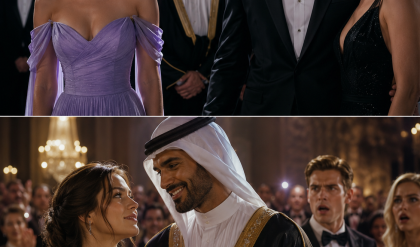
The gown was not loud. That was the first terrible thing about it. It did not scream for attention. It assumed attention would come because attention had good manners. Midnight-blue silk fell from structured shoulders into a sculpted waist and a full, controlled skirt that moved as though it remembered water. Thousands of tiny beads had been sewn into the fabric by hand, creating the impression of stars seen through deep ocean. A narrow diamond collar circled Maya’s throat. No tiara. No excessive jewelry. Nothing desperate.
She looked richer than the room.
More than that, she looked unbothered by the room.
Someone near the press line gasped, “Valorian.”
The name moved through the ballroom like electricity.
“Is that a Valorian gown?”
“Impossible.”
“Who invited Valorian?”
“No, look at her.”
“Maya Bennett?”
Garrett could not move.
For one suspended moment, memory and present collided so violently he almost forgot where he was. The woman on the staircase was not the exhausted wife he had last seen signing divorce papers. She was not the trembling girl he had once found asleep beside a sewing machine. She was not the woman society had pitied, dismissed, and buried under polite cruelty.
She was proof.
Proof that he had mistaken access for power. Proof that the world he used to impress her was smaller than the one she had created without him. Proof that some women do not recover by becoming who they were before. They recover by becoming someone their past no longer deserves to recognize.
Maya descended the staircase.
Eleanor Cole was the first to clap.
That mattered. In rooms like this, Eleanor’s approval was not applause. It was permission. A second later, others joined, uncertain at first, then louder. Cameras exploded. Reporters surged toward the rope line. Caroline’s face tightened into a smile so strained it looked painful.
Maya reached the bottom step.
Eleanor approached her, took both her hands, and said warmly enough for nearby microphones to catch, “Maya, my dear. You look extraordinary.”
Maya’s smile was soft. “Thank you, Eleanor.”
Not Mrs. Cole.
Not Mother.
Eleanor understood and respected it.
Garrett took one step forward before he realized he had moved. Caroline appeared at his side instantly, her fingers closing around his arm.
“Don’t,” she whispered.
He looked down at her hand.
For the first time, her touch felt like a claim he had not agreed to.
Maya crossed the ballroom with Eleanor beside her. People parted not because she pushed through them, but because suddenly everyone needed her to notice them. The same women who once asked whether she felt overwhelmed by “Garrett’s lifestyle” now smiled with hungry admiration. Men who had dismissed her as decorative now leaned forward, trying to place her in some hierarchy they understood.
She gave them almost nothing.
That was the second terrible thing for Caroline.
Maya was not performing triumph. She was simply existing inside it.
At dinner, the seating chart revealed Caroline’s final cruelty. Maya had been placed at a table near the back, beside minor donors, a retired soap actor, and a wellness influencer famous for divorce podcasts. It was the kind of insult that could be called an accident if challenged.
Maya reached her assigned table, glanced at the card, and smiled.
Then Eleanor Cole stepped to the microphone.
“One more announcement before dinner,” she said. “Tonight, our foundation is honored by a surprise lead gift. A contribution large enough to fund pediatric surgical fellowships across five hospitals for the next decade.”
The room hushed.
Eleanor turned toward Maya. “The donor requested discretion, but I believe generosity deserves gratitude. Ladies and gentlemen, please join me in thanking Ms. Maya Bennett, founder and creative director of Valorian House.”
For a moment, the room did not understand.
Then it understood all at once.
The applause came like weather.
Caroline’s mouth fell open before she could stop it. Lila Crane whispered something vulgar. Garrett gripped the back of a chair. Reporters began shouting questions despite the formal setting.
Founder.
Creative director.
Valorian House.
Maya stood calmly as the entire ballroom rose around her. She did not look at Caroline. She did not look at Garrett. That was what made it unbearable. Revenge would have acknowledged them. Maya’s indifference erased them.
When the applause softened, Eleanor continued, “Ms. Bennett has also agreed to auction a private Valorian commission tonight, with all proceeds benefiting the children’s surgical wing.”
A billionaire from Dallas lifted his paddle before the auctioneer even reached the podium.
The room laughed, then turned predatory.
The bidding opened at two hundred thousand dollars.
Within thirty seconds, it crossed one million.
By the time it ended at four point seven million, Caroline had stopped smiling entirely.
After dinner, the ballroom transformed into a glittering social battlefield. Everyone wanted Maya. Fashion editors surrounded her. Investors offered partnerships. Actresses begged for appointments. Two senators requested introductions. A tech founder’s wife tried to pretend she had always known Maya was brilliant.
Maya accepted compliments with grace and offers with caution.
Then Caroline approached.
Garrett saw it from across the room and moved before thinking. Miles caught his sleeve.
“Let them,” Miles said.
“This isn’t your fight.”
“No,” Miles replied. “That’s exactly what you should have realized years ago.”
Caroline stopped in front of Maya with a glass of untouched champagne in her hand. Her smile had returned, but it had lost its shine.
“Maya,” she said. “What a surprise.”
“Caroline.”
“You look…” Caroline glanced at the gown. “Expensive.”
Maya smiled faintly. “That was the goal.”
A few people nearby pretended not to listen while listening with their entire bodies.
Caroline tilted her head. “I had no idea you were Valorian. You kept that very quiet.”
“Successful women usually do before they become inconvenient.”
A tiny ripple moved through the circle.
Caroline’s eyes hardened. “I hope you didn’t misunderstand the invitation. It was meant kindly.”
“Of course,” Maya said. “Nothing says kindness like seating someone beside a podcast host who asked me whether divorce made me more relatable.”
Someone coughed into a napkin.
Caroline’s cheeks flushed. “You always were dramatic.”
Maya stepped closer, lowering her voice just enough to make everyone lean in. “No, Caroline. I was poor. People like you often confuse the two because poverty makes pain visible, and visibility makes cruelty easier.”
Caroline’s fingers tightened around her glass.
Maya continued, still calm. “You invited me here because you thought shame was a dress I still owned. I came because I wanted you to see I had it altered.”
The silence that followed was almost tender in its brutality.
Caroline looked toward Garrett as if expecting rescue.
Garrett did not move.
That was not courage. Not yet. But for Caroline, it felt like betrayal.
Maya glanced at him then. One brief look. Enough to make his chest tighten.
Then she turned and walked away, leaving Caroline standing in the wreckage of a joke that had become a coronation.
By midnight, the internet had chosen its queen.
Clips of Maya descending the staircase spread before dessert ended. By one in the morning, every fashion account in America had identified the gown. By two, anonymous sources confirmed Maya Bennett was the founder of Valorian House. By three, headlines began writing themselves with the hunger of machines.
Billionaire’s Ex-Wife Revealed as Secret Designer Behind America’s Most Exclusive Couture Brand.
Mistress Invites Poor Ex as Joke—She Arrives Richer Than the Room.
The Woman Manhattan Mocked Just Bought the Spotlight.
Garrett sat in the back of his town car after the gala, Caroline rigid beside him, both of them illuminated by passing city lights and the blue glow of phones exploding with notifications.
“This is your fault,” Caroline said.
He looked out the window. “No.”
She turned sharply. “Excuse me?”
“This is what she built. You just gave her an entrance.”
Caroline stared at him as though he had slapped her. “You’re admiring her.”
“I’m recognizing reality.”
“You humiliated me tonight.”
Garrett laughed once, without humor. “Caroline, you planned to humiliate my ex-wife at a charity gala.”
“And you let me.”
The truth arrived between them like a third passenger.
Garrett did not deny it.
Caroline’s voice dropped. “You still love her.”
Outside, Manhattan blurred white and gold through falling snow.
Garrett closed his eyes.
“I don’t know what I deserve to call it,” he said.
Caroline did not speak for the rest of the ride.
The next morning, Maya woke to seventeen missed calls, four hundred unread messages, three interview requests from national networks, and one voicemail from Garrett.
She deleted the voicemail without listening.
Jonah arrived at nine with coffee, three newspapers, and the expression of a man trying not to scream joy in a residential neighborhood.
“You are on every front page,” he said, spreading them across her kitchen island. “Not just fashion. Business. Society. Culture. One financial analyst called Valorian ‘the most valuable privately held luxury mystery in America.’ I want that phrase embroidered on pillows.”
Maya sipped coffee. “No pillows.”
“Fine. Robes.”
“No.”
“You’re impossible.”
“I’m focused.”
Jonah slid a tablet toward her. “You need to see one thing.”
It was a video from the gala. Not the staircase. Not the announcement. Not Caroline’s public unraveling. It was a zoomed-in clip of Garrett watching Maya from across the ballroom. His expression had gone viral because the internet, cruel and perceptive, recognized regret faster than wealth could hide it.
The comments were merciless.
That man just realized he divorced the plot twist.
He fumbled an empire in heels.
She didn’t upgrade. She became the upgrade.
Maya placed the tablet facedown.
Jonah studied her. “Does it hurt?”
She considered lying, then decided she had outgrown that too. “A little.”
“That’s allowed.”
“I know.”
“No, I mean it. Being powerful doesn’t mean becoming marble.”
Maya looked toward the snowy garden behind the brownstone. “I don’t want him destroyed.”
Jonah blinked. “That is very mature and deeply disappointing for those of us who enjoy justice.”
“I want him to understand.”
“That sounds worse.”
“It is.”
At noon, Garrett called again from an unknown number.
Maya almost ignored it. Then something in her, not longing but curiosity, answered.
“Hello.”
Silence.
Then his voice. “Maya.”
She looked down at the sketches on her desk. “How did you get this number?”
A pause. “Jonah gave it to my assistant five years ago, before everything.”
“Then your assistant has a better memory than you.”
He breathed out slowly. “You were incredible last night.”
“I know.”
The answer startled him. She heard it in the silence.
“I wanted to apologize,” he said.
“For last night or for the marriage?”
Another pause. Longer.
“Both.”
Maya walked to the window. Brooklyn lay quiet beneath snow, brownstones lined in white, a delivery cyclist moving carefully along the street. “You don’t get to combine them for efficiency.”
“I know.”
“Do you?”
He said nothing.
Maya closed her eyes, not because his voice weakened her, but because it reminded her of rooms where she once made herself smaller to keep love alive. “Garrett, what Caroline did last night was cruel. What you did years ago was worse because you called it concern.”
His breath changed.
“You told me I was dreaming too loudly,” she continued. “You let people laugh at me because correcting them would have cost you comfort. You watched me shrink and then complained I wasn’t the woman you married.”
“Maya.”
“No. Listen, because this is the last unpaid emotional labor I will ever do for you.” Her voice remained steady. “You didn’t leave me because I failed in your world. You left because I made you question it. And instead of becoming brave, you became respectable.”
The line stayed quiet long enough that she thought he might hang up.
When he spoke again, his voice was lower. “You’re right.”
She had imagined hearing those words once. Years earlier, they might have saved something. Now they simply arrived late to an empty station.
“I know,” she said softly.
“I loved you.”
“I know that too.”
“Then why does it sound like it doesn’t matter?”
Maya opened her eyes. “Because love without courage becomes another form of harm.”
There it was. The sentence neither of them escaped.
Garrett swallowed audibly. “Is there any way for me to make it right?”
“Not with me.”
The answer came gently, which somehow made it final.
“You can become better,” she said. “But don’t confuse that with getting access to the woman who survived you.”
He did not respond.
“Goodbye, Garrett.”
She ended the call before her voice could remember old habits.
For three weeks, Garrett Cole became a man haunted by headlines.
He saw Maya everywhere. On magazine covers. In business segments. In fashion essays written by critics who used words like sovereignty and reinvention. Valorian House, once the secret obsession of the elite, became the center of American luxury almost overnight. Department stores offered floors. Celebrities posted tributes. Investors leaked absurd valuations. A documentary producer called Jonah offering eight figures for Maya’s story and was told, politely, to develop taste before calling again.
Garrett’s empire remained enormous, but for the first time in his adult life, he felt old inside it.
Not elderly. Not weak.
Old in the way certain buildings become old when a new skyline rises around them.
At board meetings, he missed details. In negotiations, he lost patience. At charity events, people asked him about Maya with smiles too polished to be innocent. Some congratulated him, as if having once been married to greatness was an accomplishment. Others studied him with the fascination reserved for men who had sold Apple stock in 1980.
Caroline grew sharper every day.
One night, in the penthouse, she threw a magazine onto the dining table. Maya’s face stared up from the cover beneath the headline: THE WOMAN WHO DESIGNED HER OWN RETURN.
“I’m sick of seeing her,” Caroline snapped.
Garrett did not look up from his drink. “Then stop buying magazines with her on the cover.”
“I didn’t buy it. It was delivered. Everything with her is delivered now. Newsletters, invitations, stupid think pieces about feminine power. She’s a dressmaker, Garrett.”
He looked at her then.
The room chilled.
Caroline realized too late she had said the wrong thing in the wrong tone.
“My mistake,” she said bitterly. “A billionaire dressmaker.”
Garrett set down his glass. “Why did you invite her?”
“We’ve been over this.”
“No. Not the performance answer. The real one.”
Caroline laughed. “Because I wanted to see if she still mattered to you.”
He absorbed that.
“And?” he asked.
Her face changed.
That single word did more damage than an accusation. It told her the test had worked and she hated the result.
“She doesn’t want you,” Caroline said.
“I know.”
“She looked through you.”
“I know.”
“Then why are you still standing there like a man waiting outside a locked church?”
Garrett looked toward the windows. Snow had turned to rain against the glass. “Because I’m beginning to understand I burned it down while she was still inside.”
Caroline’s anger faltered, and beneath it, for just a second, there was something almost human. “And what was I?”
He turned back to her. “A match I blamed for my hand.”
She slapped him.
The sound cracked through the penthouse. Garrett did not move. Caroline stared at her own hand as if surprised by its honesty.
“I loved you,” she whispered.
Garrett’s expression softened, but not enough. “I think you loved winning.”
Tears brightened her eyes, furious and humiliated. “And you loved being worshiped. Don’t act like she was the only victim of your cowardice.”
That landed.
Because it was true.
Caroline had been cruel, yes. Vain, yes. But Garrett had used her too. He had let her become proof that he had chosen the right world after Maya. He had mistaken admiration for peace and possession for love. Caroline had entered the empty room he left behind and decorated it with ambition.
Neither of them had been innocent.
By morning, Caroline moved out.
The tabloids called it explosive. In truth, it was quiet. She took jewelry, clothes, two paintings she insisted were gifts, and the little white dog Garrett had never liked. Before leaving, she paused at the elevator.
“You know what the worst part is?” she asked.
Garrett stood in the foyer, unshaven, exhausted. “What?”
“She became everything I pretended to be.”
Then she was gone.
Months passed.
Maya did not slow down. She opened the Valorian Atelier in a restored Beaux-Arts building in Tribeca, but calling it a store was like calling a cathedral a room. The entrance was hidden behind bronze doors with no logo, only a small V carved into stone. Inside, clients walked through spaces designed to feel like chapters of transformation: a room of raw muslin and unfinished seams, a black-marble salon of mirrors and candlelight, a private fitting chamber lit like dawn.
People said the place felt sacred.
Maya disliked that word but understood why they used it. Women came to Valorian not only to buy clothing. They came to be seen without being consumed. Actresses came after divorces. CEOs came before hostile takeovers. Heiresses came when they were tired of looking inherited. Maya listened to them, sketched them, dressed them not as fantasies but as declarations.
Garrett received an invitation to the opening.
No note.
Just thick cream paper, black lettering, and the Valorian crest.
He almost did not go. Then, on the night of the opening, he found himself standing outside the Tribeca building in a black coat, watching photographers crowd behind barricades and celebrities vanish through the bronze doors.
Inside, he was not important.
That realization came quickly and without drama. No one rushed to greet him. No one guided him to a front position. No one treated him like a central figure in the story. He was simply one more wealthy man in a room full of them, and the humility of that should not have felt as radical as it did.
Then Maya appeared.
She wore white.
That startled him most. Not black, not midnight-blue, not armor. White silk, clean lines, no diamonds except small earrings. She looked less like a woman proving a point and more like a woman who had stopped needing points altogether.
Beside her stood a man Garrett did not recognize.
Tall, early forties, with dark blond hair, a neatly trimmed beard, and the relaxed posture of someone who had never begged a room to respect him. He wore a charcoal suit without flash. When a photographer called Maya’s name, he stepped back instinctively, allowing her the frame. When she turned to answer a journalist’s question, he handed her water without interrupting. The gesture was small.
It devastated Garrett.
Miles, who had arrived beside him uninvited because he believed disasters required witnesses, leaned close. “That’s Nathaniel Cross.”
“The architect?”
“And hotel heir. Cross & Vale properties. Worth more than most countries’ art budgets.” Miles paused. “He designed this place with her.”
Garrett watched Nathaniel look at Maya—not with ownership, not with hunger, but with attention. Careful attention. The kind Garrett once thought unnecessary because he had mistaken proximity for intimacy.
“Are they together?” Garrett asked.
Miles gave him a sideways look. “Does it matter?”
No.
Yes.
It mattered in the primitive place regret lives.
During the opening speech, Maya stood beneath a suspended installation of white fabric panels moving gently like breath.
“When I began designing,” she said, “I thought beauty was something people allowed you to make after they approved of who you were. I was wrong. Beauty can be a refusal. A refusal to disappear, to shrink, to be translated by people who benefit from misunderstanding you.”
The room listened with complete stillness.
Garrett felt each word find him.
“Valorian was born in secrecy,” Maya continued. “Not because I was ashamed, but because I was protecting something while it learned to breathe. Tonight, it no longer needs secrecy. It needs space. So we built one.”
We.
Garrett looked at Nathaniel.
Nathaniel was looking at Maya.
Not proudly like a man displaying a woman.
Proudly like a man witnessing the sun rise exactly where she said it would.
After the speech, guests gathered around Maya. Garrett stayed near the edge until he hated himself for hiding and hated himself more for wanting to be seen. Eventually, he approached when she stood briefly alone beside a sculpture of pale silk.
“Maya.”
She turned.
No surprise. No anger. “Garrett.”
“The atelier is beautiful.”
“Thank you.”
He looked around. “It feels like you.”
A faint smile touched her mouth. “The current version, yes.”
He nodded slowly. “I deserved that.”
“It wasn’t punishment.”
“No. That’s worse.”
For a moment, something almost gentle passed through her eyes. Not affection. Recognition, maybe, of the man he was trying too late to become.
Nathaniel approached then, carrying two glasses of water. He handed one to Maya, then looked at Garrett with calm politeness.
“Nathaniel Cross,” he said.
“Garrett Cole.”
“I know.”
No hostility. No admiration either.
Garrett almost smiled at the fairness of it. “Of course.”
Maya looked between them, and in another life Garrett might have interpreted the moment as rivalry. But Nathaniel did not posture. He did not claim. He simply stood beside her without needing to dominate the space.
That, Garrett realized, was a form of wealth he had never learned.
“I should let you get back to your guests,” he said.
Maya nodded. “Take care, Garrett.”
It was the same phrase she had used before.
This time he heard what lived inside it.
Not cruelty.
Distance.
A year later, Valorian became the most influential private fashion house in the United States. Maya’s net worth crossed into billionaire territory, though she refused to confirm the number publicly. She launched scholarships for first-generation design students, funded legal support for exploited garment workers, and quietly bought the Queens building where she had once lived, converting it into subsidized studios for young artists.
That was the detail that finally broke Garrett open.
Not the money. Not the headlines. Not Nathaniel Cross.
The building.
He went there one rainy afternoon without telling anyone. The neighborhood had changed, but not completely. The laundromat was still on the corner. The bodega still sold coffee too bitter to be legal. The old brick building looked cleaner now, its windows repaired, its lobby painted warm cream. A brass plaque near the entrance read: THE BENNETT STUDIOS—AFFORDABLE WORKSPACES FOR EMERGING ARTISTS.
Inside, sewing machines hummed. A young woman carried rolls of fabric up the stairs. Someone laughed behind a door. Music played softly from a studio where two students argued about sleeve structure.
The landlord, Mrs. Alvarez, recognized him before he introduced himself.
“You were her husband,” she said.
Garrett stood in the hallway, rain dripping from his coat. “Yes.”
She did not invite him farther in.
“Did she suffer here?” he asked before pride could stop him.
Mrs. Alvarez studied him with tired eyes. “Everyone suffers a little when rent is due.”
“I mean because of me.”
“Ah.” She looked toward the staircase. “That kind of suffering she brought with her. But she did not keep it like furniture.”
He swallowed.
“She worked?” he asked.
Mrs. Alvarez laughed softly. “Like the devil was chasing her and God was taking notes. That machine ran all night. Sometimes I worried she would make herself sick.”
Garrett looked up the stairs, imagining Maya younger, thinner, alone under bad lighting, building the future he had called unrealistic.
“Was she angry?”
“At first.” Mrs. Alvarez’s expression softened. “Then busy. Busy is better than angry if you use it right.”
Garrett nodded, unable to speak.
Before he left, Mrs. Alvarez said, “She came back last month for the opening. She cried in the old apartment.”
That pierced him.
“She cried?”
“Not sad tears.” Mrs. Alvarez smiled. “The kind you cry when the ghost finally moves out.”
Garrett walked back into the rain feeling as though someone had opened his chest and removed the last defense.
That evening, he did something he had not done in years. He opened the storage room in his penthouse where boxes from his marriage had been placed and forgotten. Most contained household objects, books, old photographs, things assistants had packed because neither he nor Maya could bear to sort them. At the bottom of one box, wrapped in tissue, he found a sketchbook.
Maya’s sketchbook.
He sat on the floor for hours turning pages.
There were gowns inspired by storms, bridges, opera houses, winter trees. Notes in the margins. Fabric calculations. Small lines of frustration. A coffee stain shaped like a continent. On one page, she had drawn a dress with sharp shoulders and a full dark skirt, then written: For the night they expect me to disappear.
Garrett stared at that sentence until his vision blurred.
He had not ruined her dream.
That would have been easier to forgive himself for.
He had forced her to build it against him.
Two months later, the Valorian Foundation announced a final event of the season: The Becoming Gala, held not at the Sterling Grand but at the newly restored Hudson Armory, a massive glass-and-stone structure overlooking the river. It would celebrate artists who rebuilt their lives after public failure, poverty, divorce, illness, or exile. Tickets were impossible to buy. Invitations were rarer than forgiveness.
Garrett received one.
Again, no note.
This time, he understood the invitation was not hope. It was not a message hidden in expensive paper. It was simply proof that Maya no longer needed to exclude him to be free.
He attended alone.
The Hudson Armory did not resemble the Sterling Grand. There were no chandeliers trying to outshine the guests, no marble floors polished into intimidation. The space was warm, modern, alive with art made by people who had known what it meant to start over. Sculptures rose from reclaimed steel. Dresses hung beside photographs of the women who had inspired them. Young designers stood beside patrons without lowering their voices.
At the center of the hall was a display that made Garrett stop.
A simple sewing machine on a wooden table.
Beside it, behind glass, lay the sketchbook.
His sketchbook.
No.
Hers.
A small plaque read: FIRST VALORIAN ARCHIVE, QUEENS, NEW YORK. ON LOAN FROM MAYA BENNETT.
Garrett’s pulse changed. She had recovered it somehow. Or someone had returned it. He wondered whether she knew he had read it. Shame moved through him, but not defensively anymore. He let it pass through.
Then Maya took the stage.
She wore a black-and-ivory gown tonight, simple and stunning, neither armor nor surrender. Nathaniel stood near the front, not beside her, not behind her, but among the people listening. His place did not need advertisement.
Maya looked out over the hall.
“I used to believe becoming meant proving the right people wrong,” she said. “That if the people who doubted me could finally see me clearly, the wound would close.”
Garrett stood near the back, still as stone.
“But wounds do not close because someone else becomes sorry,” Maya continued. “They close when you stop needing the person who hurt you to become the witness to your healing.”
The room went silent in the old way, the Maya way, the silence that did not empty a space but filled it with truth.
“Tonight is not about success as revenge,” she said. “It is about success as return. Return to self. Return to courage. Return to the parts of us we abandoned in order to be loved badly.”
Garrett lowered his head.
Not because he was being publicly shamed. She had not named him. She did not need to.
Because for the first time, he understood that her story was no longer organized around his failure.
That was what made it beautiful.
That was what made it unbearable.
After the speech, the gala bloomed around her. Artists cried. Donors wrote obscene checks. Young designers surrounded Maya with the kind of gratitude that made legacy feel less like inheritance and more like responsibility. Garrett stayed for an hour, then stepped outside onto the terrace overlooking the Hudson.
Cold air moved over the river. Across the water, Manhattan glittered with all its old promises. He had spent his life believing the city belonged to men like him. Tonight it looked larger, less owned, more merciful.
Footsteps approached.
He did not turn until Maya stood beside him.
For a while, neither spoke.
Finally, Garrett said, “You got the sketchbook back.”
“Your mother sent it.”
He looked at her. “My mother?”
Maya nodded. “After the atelier opening. She said some things should return to the person who survived them.”
A small, broken laugh left him. “That sounds like her.”
“It does.”
Silence settled again, but it was not hostile. That almost hurt more.
“I read it,” he admitted.
“I know.”
He closed his eyes briefly. “I’m sorry.”
“For reading it or for making those pages necessary?”
“Both.”
Maya looked out over the river. “I believe you.”
He turned toward her, hope rising before he could kill it.
She saw it. Of course she did.
“And I forgive you,” she said.
The words struck him so hard he almost stepped back.
For years, he had imagined forgiveness as a bridge. A way across. A door reopening. But Maya’s voice held no invitation. It held release.
He understood before she explained.
“Forgiveness does not mean access,” she said gently.
Garrett nodded, his throat tight. “I know.”
“Do you?”
“I’m learning.”
For the first time, she looked at him with something close to warmth. Not love. Not the old softness. Human kindness, perhaps, which was more than he deserved and less than he wanted.
“You should stop coming to my events as punishment,” she said.
He let out a breath. “Is that what it looks like?”
“It looks like a man confusing regret with devotion.”
Caroline had said the same thing once. Garrett almost smiled at the cruelty of truth repeating itself until understood.
“You’re right,” he said.
Maya’s expression softened. “Garrett, I don’t hate you.”
“I know.”
“No, listen. I don’t hate you. I don’t need you ruined. I don’t need you lonely. I don’t need your life to become small because mine became large.” She turned fully toward him. “But I cannot be the place where you go to forgive yourself.”
His eyes burned.
“I don’t know how,” he said.
“That’s honest.”
“It’s not enough.”
“No,” she agreed. “But it’s a beginning.”
Below them, the river moved black and silver under the city lights.
Garrett looked through the glass doors toward the gala, where Nathaniel was speaking with a group of scholarship students. He glanced once toward the terrace, saw Maya and Garrett, and did not interrupt. No insecurity. No performance. Trust, quiet and complete.
“He loves you well,” Garrett said.
Maya followed his gaze. A small smile appeared. “Yes.”
That smile no longer stabbed him the way it once had. It still hurt, but differently. Like touching a scar and realizing it had become part of the skin.
“I’m glad,” he said, and surprised himself by meaning it.
Maya studied him for a moment. “That may be the bravest thing you’ve ever said to me.”
He laughed softly, painfully. “Low bar.”
“Still.”
Another silence.
Then Garrett reached into his coat and removed an envelope. “I brought something.”
Maya did not take it immediately.
“It’s not for you personally,” he said quickly. “It’s for the foundation. No conditions. No publicity. No name on anything.”
“What is it?”
“The deed to the old Cole textile mill in Massachusetts. It’s been empty for years. I thought…” He swallowed. “I thought it could become a production school. Or artist housing. Or whatever you decide. It should belong to people who make things.”
Maya looked at the envelope, then at him.
“Why?”
He searched for the old answers—redemption, apology, legacy—but none felt clean enough.
“Because I spent too much of my life rewarding people who already owned rooms,” he said. “I’d like to help build one for people who don’t.”
She accepted the envelope.
Not warmly. Not dramatically.
But she accepted it.
“Thank you,” she said.
Those two words gave him no absolution. Strangely, that made them feel real.
Inside, music began. The gala shifted toward dancing. Through the glass, Garrett saw young artists laughing with millionaires, designers explaining seams to donors, Eleanor Cole seated beside Mrs. Alvarez as if old money and rent-controlled wisdom had always belonged at the same table. Caroline Whitaker was there too, unexpectedly, standing near a sculpture with a glass of sparkling water. She looked different. Less polished, maybe. Or simply less hungry. She met Garrett’s eyes through the glass and lifted her drink in a small, ironic toast.
Maya noticed.
“I invited her,” she said.
Garrett turned, startled. “Caroline?”
“She donated to the scholarship fund.”
He blinked. “Caroline did?”
“Quietly. Through a shell LLC, very dramatic.” Maya’s mouth curved. “Jonah found out in twelve minutes.”
Garrett looked back through the glass at Caroline. She was speaking to a young designer now, listening more than talking.
“She told me something,” Maya said.
“What?”
“That becoming better is humiliating at first because no one applauds you for returning what you should never have stolen.”
Garrett absorbed that. “She said that?”
“She’s funnier when she’s not trying to win.”
For the first time in years, Garrett laughed without bitterness.
Maya smiled, then grew thoughtful. “People can change, Garrett. But change is not a receipt you hand to the person you hurt. It’s a life you live whether or not they ever trust you again.”
He nodded slowly. “I understand.”
And this time, he almost did.
A week later, Garrett resigned from two vanity boards and redirected a portion of Cole Meridian’s philanthropic arm toward manufacturing apprenticeships, artist legal aid, and women-owned creative businesses. The press called it a pivot. Analysts called it strategic repositioning. Miles called it “late-stage conscience with tax benefits.” Garrett let them talk. For once, he did not need the story shaped around his dignity.
Caroline moved to Los Angeles and started a foundation for image rehabilitation in the entertainment industry, which sounded ridiculous until it helped three actresses fight predatory contracts. She still wore expensive clothes. She still enjoyed attention. But she no longer mistook cruelty for cleverness, at least not most days.
Eleanor Cole joined Valorian’s board and terrified everyone into efficiency.
Nathaniel designed the Massachusetts textile mill conversion, refusing payment beyond one dollar and the right to argue with Maya about windows. Their arguments became famous among the staff because they were never cruel. They were storms that cleared the air. Six months after the Becoming Gala, he proposed to Maya privately in the unfinished mill, under newly installed skylights, with no photographers and no ring box hidden in dessert. He simply asked, “Would you like to keep building beside me?”
Maya cried before she said yes.
Not because she needed marriage to complete the story.
Because this time, love did not ask her to become smaller in exchange for safety.
Garrett heard the news from Miles, who delivered it in person because friendship sometimes required controlled injury.
“You okay?” Miles asked.
Garrett stood in his office, looking out over Manhattan. For a moment, the old pain moved through him. Not sharp enough to destroy. Honest enough to respect.
“Yes,” he said.
Miles raised an eyebrow. “That was suspiciously healthy.”
Garrett smiled faintly. “I’m trying something new.”
That evening, he wrote Maya a letter. Not an email. Not a text. A letter on plain paper, without lawyers or assistants or expensive formatting.
Maya,
Congratulations.
I hope this next chapter gives you the quiet happiness you deserved long before anyone knew your name. I used to think losing you was the great tragedy of my life. I was wrong. The tragedy was becoming the kind of man who could lose you and still believe the world owed him comfort.
Thank you for forgiving me without returning to me.
I understand the difference now.
Garrett
He did not expect an answer.
Two weeks later, a small envelope arrived at his office.
Inside was a card embossed with the Valorian crest. Beneath it, in Maya’s handwriting, were four sentences.
Garrett,
I’m glad you understand.
Build something good with what you know now.
That is enough.
Maya
He kept the card in his desk, not as proof of hope, but as a reminder that some doors close not to punish us, but to teach us where we are meant to begin again.
Years later, people still talked about the night Maya Bennett walked into the Sterling Grand Hotel wearing a million-dollar dress and silenced a ballroom built to laugh at her. They remembered Caroline’s shattered champagne flute, Garrett Cole’s pale face, Eleanor’s first clap, the auction that raised millions, the headlines that crowned a woman no one had expected to rise.
But those who knew the whole story understood that the dress was not the miracle.
The miracle had happened in smaller rooms long before that staircase.
It happened when Maya sewed through hunger. When she chose rent over revenge. When she built Valorian under a name no one could steal. When she stopped begging powerful people to see her and became powerful enough to see herself. It happened when she forgave without surrendering, loved again without disappearing, and turned the places that once held her pain into doors for others.
On the morning of her wedding, Maya stood alone for a moment in the Massachusetts mill, now transformed into the Bennett-Cross School of Design and Textile Arts. Sunlight poured through Nathaniel’s beloved windows onto rows of sewing tables where students would begin classes the following fall. Her gown was not the famous midnight-blue one. It was simple ivory silk with hidden seams, designed so beautifully that only experts would understand how difficult it was.
Jonah entered behind her, already crying.
“You are not allowed to start,” Maya warned.
“I started last night,” he said. “This is the continuation.”
She laughed.
Eleanor appeared next, carrying a small velvet box. “Something borrowed,” she said.
Inside was a pair of pearl earrings.
Maya looked at them, then at Eleanor. “Are you sure?”
“My dear,” Eleanor said, “I have spent decades watching this family confuse wealth with worth. Let me enjoy one good decision.”
Maya hugged her.
Outside, guests gathered in the courtyard. Artists, students, billionaires, seamstresses, actresses, architects, old friends, former enemies, people who had broken and rebuilt themselves in public and private ways. Caroline arrived in pale gold and sat beside Miles, who immediately said something that made her roll her eyes. Garrett came alone, took a seat near the back, and did not try to be seen.
When Maya walked down the aisle toward Nathaniel, she passed Garrett’s row.
For half a second, their eyes met.
In another story, that look might have been tragic. In a crueler one, it might have been revenge. But this was neither. This was recognition. Two people acknowledging that love had existed, harm had happened, consequences had remained, and life—strange, generous, merciless life—had continued.
Garrett stood with everyone else.
He clapped when the ceremony ended.
And when Maya kissed Nathaniel beneath the open sky, Garrett felt the final piece of his regret loosen, not vanish, but become something he could carry without making it the center of every room.
After the ceremony, Maya found him near the edge of the courtyard, watching students from the first scholarship class take pictures beside the old brick wall.
“Thank you for coming,” she said.
He turned. “Thank you for inviting me.”
A breeze moved through the courtyard, lifting the edge of her veil.
“You look happy,” he said.
“I am.”
“I’m glad.”
“I know.”
He smiled. “You always do.”
For a moment, they stood as people who had once shared a life and now shared only the dignity of having survived its ending.
Then Maya touched his arm lightly. “Take care of yourself, Garrett.”
This time, the words did not sound like distance.
They sounded like peace.
“I will,” he said.
And he meant it.
Maya returned to Nathaniel, to laughter, to sunlight, to the life she had built stitch by stitch from the ruins of someone else’s doubt. Garrett watched her go, not as a man abandoned, not as a man punished, but as a man finally humble enough to understand the gift hidden inside loss.
Some women do not come back to prove you wrong.
Some women come back once, shining under chandeliers, so you can understand that they were never yours to diminish.
And after that, if they are wise, they keep walking toward the life that was waiting for them all along.
THE END