“She’s heavily sedated,” he said. “Pulse is weak. Pressure’s dropping. Do you know what happened?”
Margaret looked through the rear windows at the city blurring behind them. Grant had once run those streets as a boy, coming home with grass stains and excuses. She had believed him every time.
“No,” she said. “But I know who did it.”
At St. Catherine’s Medical Center, Hannah vanished behind swinging emergency doors. Margaret was left in a waiting room that smelled of coffee, sanitizer, and human fear. Her hands were still stained with blood from Hannah’s note.
She called Hannah’s mother first.
Teresa Cole answered on the fourth ring, breathless. “Margaret? I’m on I-95. I couldn’t get a morning flight, so I started driving. Is it true? Is my daughter really gone?”
Margaret closed her eyes.
“No,” she said, and her voice broke. “Teresa, listen to me carefully. Hannah is alive.”
There was no sound on the line.
Then Teresa whispered, “Don’t play with me.”
“I would never. She’s in the emergency room. She was buried alive, and the baby is alive too. But the baby is missing.”
A sharp cry tore through the phone.
Margaret held it tighter. “Drive safely. Come straight to St. Catherine’s. I swear to you, Teresa, I will not leave her.”
“You should have protected her,” Teresa said.
The words landed exactly where they belonged.
Margaret did not defend herself.
“I know.”
When she hung up, Officer Bell and a hospital social worker named Denise found her near the vending machines. Denise had kind eyes, but her mouth was set with professional urgency.
“Mrs. Whitaker,” Officer Bell said, “we need that note.”
Margaret pulled it from her dress and handed it over. He slid it into an evidence sleeve.
Denise read the words through the plastic. “Find Elise in Richmond Hill. Do you know who that is?”
Margaret’s throat tightened.
Yes, she knew.
Elise Monroe had come to Grant’s office twice under the pretense of commissioning a necklace. She was thirty-five, polished, beautiful in the cold way expensive things were beautiful. She had once stood in Margaret’s kitchen holding a glass of sweet tea, staring at Hannah’s pregnant belly with such hunger that Margaret had felt embarrassed for noticing.
Grant had said Elise was lonely.
Grant had said Elise had lost three pregnancies.
Grant had said Hannah should be kinder because some women would give anything to be in her position.
Hannah had gone quiet after that. Later, Margaret had found her on the back porch with her hands over her stomach.
“Is everything all right?” Margaret had asked.
Hannah had smiled too quickly. “Yes, ma’am.”
Margaret hated herself now for accepting that answer.
“I know an Elise,” she told Officer Bell. “Elise Monroe. She lives near Richmond Hill, I think. Grant said she was a client.”
“Client for what?”
“My son manages Whitaker & Sons, our family jewelry store downtown.”
Officer Bell’s expression shifted. “Does he have access to cash, private accounts, valuables?”
“He has access to everything I was foolish enough to trust him with.”
Before the officer could answer, a doctor emerged from the double doors.
“Family of Hannah Whitaker?”
Margaret stood. “Here.”
The doctor was a woman in blue scrubs, her hair pinned messily under a cap. Her face was tired but steady.
“I’m Dr. Latham. Hannah is alive, but she is critical. She has signs of recent childbirth, major blood loss, blunt-force injuries, dehydration, and heavy sedation. We also found abrasions on her hands consistent with scratching a hard surface.”
Margaret gripped the back of a chair.
Dr. Latham continued, “I need to ask where she delivered.”
“Grant said here.”
The doctor shook her head. “We have no admission record for Hannah Whitaker in the last forty-eight hours. No delivery record. No death certificate. No neonatal death certificate.”
Denise went pale.
Margaret whispered, “Then where did she have the baby?”
No one answered.
The question was already an accusation.
Officer Bell stepped away to make calls. Denise began filing an emergency missing infant report. Dr. Latham asked Margaret about Hannah’s medical history, medications, fears, threats, anything that might explain the note.
Margaret told the truth as far as she knew it.
That Hannah had come to Savannah two years earlier with one suitcase, a bruised wrist, and a degree in elementary education she never got to use. That Grant had first seemed protective, then possessive. That he had gradually taken over her bank account, her phone plan, her doctor visits, her friendships. That Margaret had noticed, objected weakly, and then allowed Grant to explain it away as stress, pregnancy hormones, marital privacy.
“I raised him,” Margaret said quietly. “And when he became cruel, I called it confidence. When he became controlling, I called it responsibility. When Hannah became smaller in front of me, I called it marriage being hard.”
Dr. Latham did not comfort her.
Margaret was grateful for that.
A nurse approached then, hesitant. Her badge read Lily Deveraux.
“I heard about the woman from the cemetery,” she said. “Was her name Hannah?”
Margaret looked up sharply. “Yes.”
Lily swallowed. “She came here yesterday morning. Not admitted officially, but she came through the ambulance bay with her husband. I was coming off shift. She grabbed my sleeve.”
“What did she say?”
Lily’s eyes filled. “She said, ‘Don’t let Grant take my baby.’ Then a man I didn’t recognize told me she was confused, that he was her private doctor. He showed credentials. Dr. Pike.”
Denise whispered, “The note said don’t call Dr. Pike.”
Lily nodded, trembling. “When I tried to report it, the intake entry vanished. I thought maybe I misread the situation. I went home. I should have pushed harder.”
Margaret reached for the young nurse’s hand. “So should I.”
That shared failure hung between them, but it did not stop the next step. Within minutes, Officer Bell had a patrol car ready for Richmond Hill. He told Margaret she did not have to come.
She stared at him as if he had spoken in another language.
“My granddaughter is somewhere with a woman who bought her from my son,” she said. “I am coming.”
The drive south felt longer than any road Margaret had ever traveled. Savannah’s squares gave way to highways, then pine trees and marshland. The city’s old beauty receded behind them, but Margaret could still feel it watching. Savannah had always loved its polished stories: family names, restored houses, churchgoing men, wives who smiled in public. Underneath that charm, cruelty could live for years if everyone agreed not to name it.
Margaret remembered the first dinner Hannah had shared at the Whitaker house.
Grant had brought her in during a thunderstorm. She wore a thrift-store blue dress and kept apologizing for getting rain on the floor. Margaret had asked where her family was.
“Ohio,” Hannah said. “My mom and I are close, but I wanted a fresh start.”
Grant had put his hand on the back of Hannah’s chair. “She needed someone to take care of her.”
At the time, Margaret thought it sounded romantic.
Now she heard the cage door closing.
In Richmond Hill, Officer Bell followed the address Margaret found in an old jewelry invoice stored in her email. Elise Monroe’s house sat at the end of a narrow lane behind a line of crepe myrtles. It was a neat white bungalow with pale blue shutters, the kind of place that looked too gentle for a crime.
A silver SUV sat in the driveway.
A pink baby blanket hung over the porch railing.
Margaret made a sound that did not feel human.
Officer Bell held up a hand. “Stay behind me.”
From inside the house came the unmistakable cry of a newborn.
Margaret did not stay behind him.
She was halfway up the porch before the officer reached the steps. He knocked hard.
“Police. Open the door.”
The crying stopped, then started again.
Officer Bell knocked once more. “Open the door, Ms. Monroe.”
A woman’s voice called from inside, thin with panic. “I need a minute.”
“You don’t have a minute.”
Something crashed.
Officer Bell tried the door. Locked.
Margaret saw a side window cracked open above a planter. Without thinking, she grabbed the heavy ceramic pot and smashed the glass. Officer Bell swore, reached through, unlocked the door, and pushed inside.
Elise stood in the living room with a newborn clutched against her chest.
Her hair was loose. Her makeup was smudged. A hospital-style bracelet, badly cut, still circled the baby’s ankle. On the coffee table sat a diaper bag, a stack of cash, a packet of legal documents, and a handwritten list titled Formula Schedule.
The baby was tiny, red-faced, furious, and alive.
Margaret’s knees almost failed.
“Give her to me,” she said.
Elise backed away. “No.”
Officer Bell kept his voice controlled. “Ms. Monroe, place the baby in the carrier.”
“She’s mine.”
Margaret stepped forward. “She is Hannah’s.”
Elise’s face crumpled. “Hannah didn’t want her.”
Margaret’s anger became so sharp it steadied her. “Hannah tore her nails apart inside a coffin trying to get back to that child.”
Elise flinched.
“No,” she whispered. “Grant said she died. He said she was unstable. He said the baby would go into the system if I didn’t take her. He said Hannah signed papers before the delivery.”
Denise, who had arrived in a second car, moved carefully toward Elise. “Did you see Hannah sign those papers?”
Elise began to sob. “No.”
“Did you see the baby born?”
“No.”
“Did you pay Grant Whitaker?”
Elise looked at the cash on the table.
That was answer enough.
Officer Bell took the baby gently but firmly. Elise resisted for one desperate second, then collapsed onto the sofa, her empty arms folding against her body as if the grief inside her had finally met the crime outside it.
Denise checked the baby quickly. “She needs a hospital.”
“Is she hurt?” Margaret asked.
“Cold, hungry, but breathing well.”
The baby screamed, outraged by all of them.
Margaret laughed through tears. “That’s right, sweetheart. Tell the whole world.”
Denise placed the baby in Margaret’s arms for the short walk to the car.
Margaret had held babies before. She had held Grant. She had held cousins, neighbors, church children, the infants of women who trusted her. But this child felt different. This child had been stolen from a mother presumed dead, carried into a stranger’s house, and wrapped in a lie before she had even learned how to focus her eyes.
The baby rooted against Margaret’s black funeral dress.
“I’m sorry,” Margaret whispered. “I’m sorry you came into the world surrounded by cowards.”
Officer Bell came out carrying Elise’s phone in an evidence bag.
“Mrs. Whitaker,” he said, “you need to hear this.”
He played a voice message.
Grant’s voice filled the porch.
“Stop crying, Elise. By tomorrow afternoon, Hannah will be buried and my mother will stop asking questions. The baby is yours. Keep her quiet. I handled Pike, I handled the funeral home, and I’ll handle the paperwork. Nobody listens to women when they’re hysterical, not even old ones.”
Margaret looked down at the baby.
Her granddaughter’s eyes were closed now, her tiny fist resting against Margaret’s chest.
Grant had miscalculated one thing.
Old women were not weak.
They were witnesses people had spent a lifetime underestimating.
When they returned to St. Catherine’s, the hospital had changed. The quiet panic had become organized urgency. Detectives stood by the nurses’ station. A state investigator had arrived. Dr. Pike was being sought for questioning. The funeral director was already claiming he had received a sealed order from a private physician. Grant had been detained at the cemetery after trying to leave in his car.
Margaret carried the baby into the neonatal unit under Denise’s supervision. Nurses checked her temperature, weight, reflexes, blood sugar. They found signs of a rough delivery but no immediate life-threatening injuries.
“She’s strong,” one nurse said.
Margaret closed her eyes.
“Her mother is stronger.”
It took two hours before Dr. Latham allowed the baby to be brought near Hannah. By then, Hannah had been stabilized enough to breathe without the mask for a few moments at a time, though tubes and monitors surrounded her like a mechanical prayer.
Margaret stood beside the bed with the newborn swaddled in a hospital blanket.
“Hannah,” she whispered.
Hannah’s eyelids moved.
“Sweetheart, we found her.”
For several seconds, nothing happened. Then Hannah’s fingers twitched.
Margaret lowered the baby carefully until the child’s cheek brushed Hannah’s.
The monitors changed rhythm.
Hannah opened her eyes.
The sound she made was the purest grief Margaret had ever heard. Not despair. Not relief. Both together, torn from a body that had almost been denied the chance to make it.
“My baby,” Hannah breathed.
“She’s here,” Margaret said. “She’s here.”
Hannah tried to lift her hand. Margaret guided it to the baby’s blanket.
“Grant?” Hannah whispered.
“He can’t touch either of you.”
Hannah’s eyes filled with fear before the tears spilled over. “He said nobody would believe me.”
Margaret bent close, ashamed of every year she had made that sentence possible.
“I believe you,” she said. “And I will spend the rest of my life proving it.”
Teresa Cole arrived at dawn.
She came into the hospital wearing wrinkled clothes and road dust, her gray-streaked hair pulled back crookedly, her face emptied by the kind of terror that leaves no room for manners. She did not greet Margaret. She did not ask permission. She walked straight into Hannah’s room and stopped at the bed as though her soul had struck glass.
Hannah was asleep.
Alive.
Teresa covered her mouth with both hands, then bent over her daughter and kissed every part of her face she could reach.
“My baby,” she whispered. “My Hannah. I’m here. Mama’s here.”
Hannah opened her eyes weakly. “Mom.”
That one word broke Teresa. She climbed onto the edge of the bed as carefully as she could and held her daughter’s head against her chest, rocking her the way mothers do when their children are small and when horror makes them small again.
Margaret stood near the door, holding the baby in the crook of her arm.
After a long while, Teresa looked up.
Her eyes landed on Margaret.
For a moment, neither woman spoke.
Teresa’s daughter had almost been murdered by Margaret’s son. Margaret had found the baby. Both facts stood in the room like opposing witnesses.
Margaret lowered her head. “I don’t expect forgiveness.”
“No,” Teresa said. “You don’t get to expect anything.”
“I know.”
“Did you turn him in?”
“Yes.”
“Did you hesitate?”
Margaret answered honestly. “For one second at the cemetery, I saw my little boy. Then I saw Hannah’s hands.”
Teresa looked at the bandages wrapped around her daughter’s fingers.
“What did you choose?”
“My daughter-in-law.”
Teresa’s jaw trembled.
Margaret stepped closer and offered the baby. “She needs her grandmother.”
Teresa stared at the child, and the hard lines of her face collapsed. She took the baby with a sob so quiet it was almost reverent.
“What’s her name?” Teresa asked.
“Hannah wanted to name her Mercy if she survived the delivery.”
Teresa looked at her daughter. “Then Mercy survived more than that.”
The following days brought the truth out in pieces, and each piece seemed uglier than the last because none of it had been sudden.
Grant had not acted in a moment of panic. He had planned.
Three months earlier, Hannah had called a domestic violence hotline from a grocery store bathroom. She had told the advocate her husband controlled her money, monitored her phone, and threatened to take the baby if she left. She had begun hiding copies of documents in cereal boxes, coat linings, and one envelope taped under the drawer of Margaret’s guest room.
Margaret found that envelope with Detective Bell standing beside her.
Inside were photographs of bruises. Bank statements showing transfers from Hannah’s inheritance into Grant’s private accounts. A note from a lawyer Hannah had contacted secretly. And a video stored on a small memory card.
In the video, Hannah sat in the nursery Margaret had painted pale yellow. She looked tired but determined.
“If something happens to me,” Hannah said, staring into the camera, “it was not an accident. Grant said if I left him, he would make sure no court ever handed me my daughter. He said his mother would choose him because blood always chooses blood. I don’t know if that’s true. I hope it isn’t. Mrs. Whitaker, if you see this, please call my mom. Please find my baby.”
Margaret watched it once.
Then she watched it again because punishment should not be rushed.
Detective Bell turned off the laptop gently. “Mrs. Whitaker?”
Margaret covered her face.
“She asked me to be brave before I even knew I was a coward,” she said.
The police arrested Dr. Warren Pike at a marina outside Thunderbolt while he was trying to board a friend’s boat. In his bag were fifty thousand dollars in cash, two forged death forms, and a prescription pad with Hannah’s name on it. Under questioning, he admitted to sedating Hannah at a private birthing suite Grant had rented under Elise Monroe’s name.
He claimed Hannah had “experienced complications.”
He claimed she had “become violent.”
He claimed he believed she was dead when he signed the release to the funeral home.
But the autopsy technician who had been told to prepare Hannah’s body had already confessed that Hannah’s pulse had been weak but present when she arrived. The technician called Dr. Pike. Dr. Pike told him postpartum spasms were common and threatened his license if he delayed the burial.
The funeral director had accepted a bribe to seal the coffin quickly.
Elise confessed after twelve hours. She had not known Hannah was alive, she said. She had believed Grant when he told her his wife was cruel, unstable, and willing to surrender the baby quietly. But she admitted she paid him. She admitted she did not ask enough questions because the answer she wanted was already in her arms.
Grant said nothing for three days.
When he finally requested to see Margaret, Detective Bell asked if she wanted to decline.
Margaret thought of Hannah’s broken nails.
“I’ll see him,” she said. “But not alone.”
They met in a small interview room at the county jail. Grant wore an orange jumpsuit and the expression of a man insulted by consequences. Margaret sat across from him with Detective Bell by the door.
For a few seconds, Grant looked like he might attempt tenderness.
“Mom,” he said. “This has gotten out of hand.”
Margaret almost smiled. “That is what you call attempted murder now?”
His face hardened. “You always loved strays. Hannah played you from the beginning.”
“No. She survived you from the beginning.”
“You don’t know what she was like.”
“I know what you are like.”
He leaned forward. “Everything Dad built is going to be destroyed because you’re enjoying your righteous little performance.”
There it was.
Not grief. Not remorse. The family business. The name. The money. The public story.
Margaret folded her hands. “Your father built Whitaker & Sons after his father beat him bloody for wanting more than a dock job. He built it so his family would have dignity, not so his son could buy doctors and sell babies.”
Grant’s mouth tightened. “You think Hannah is innocent? Ask her why she hired a lawyer. Ask her what she planned to take.”
Margaret stared at him.
Then she understood the final piece.
“You found out about the trust.”
Grant’s eyes flickered.
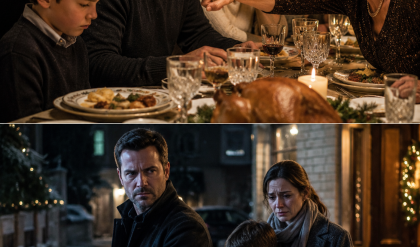
Margaret’s late husband, Thomas, had rewritten his will before he died. Grant knew about the company shares, but not about the private family trust Thomas had created after watching Grant humiliate a pregnant Hannah at Thanksgiving. Thomas had told Margaret, “That boy has a mean streak we fed for too long.” If Grant ever divorced Hannah while she was pregnant, or if Hannah gave birth to a Whitaker grandchild, controlling interest in the trust would move to Hannah and the child until the child turned twenty-five.
Margaret had never told Grant.
But Hannah had found the documents in Thomas’s old desk.
That was why she had hired a lawyer.
Grant had not only stolen the baby for Elise.
He had tried to erase Hannah because Hannah and Mercy stood between him and everything he believed he owned.
“You didn’t sell your daughter because Elise was desperate,” Margaret said. “You sold her because if Hannah lived and kept custody, she controlled the trust.”
Grant’s silence answered.
Detective Bell shifted by the door.
Margaret rose from her chair.
Grant’s mask slipped. “Mom, don’t. You can still fix this. Say Hannah was confused. Say the note could have been planted. You know how people look at our family. You know what this will do to us.”
Margaret looked at the man she had once rocked through fevers and nightmares. Motherhood did not vanish. That was the cruelty of it. Love could remain even after respect died.
“I am fixing it,” she said. “Just not for you.”
The trial did not come quickly.
Nothing after trauma does.
Hannah left the hospital eighteen days later with stitches, bandaged hands, and a fear of closed doors so severe Teresa removed the bathroom lock in the small rental house where they stayed. Margaret did not return to the Whitaker family home either. She packed a suitcase, took Thomas’s portrait from the hallway, and left the house Grant had treated like a throne.
At first, Hannah could not bear to have Margaret near for too long. It was not hatred exactly. It was the confusion of needing comfort from the mother of the man who had harmed her.
Margaret accepted whatever distance Hannah required.
She bought groceries and left them on the porch. She sat in the car during medical appointments when Teresa went inside. She hired an attorney to secure Hannah’s rights to the trust and signed an affidavit admitting everything she had ignored.
One afternoon, Teresa came outside and found Margaret sitting on the curb, holding a bag of diapers.
“You can come in,” Teresa said.
Margaret looked up. “Are you sure?”
“No. But Mercy needs changing, Hannah needs sleep, and I am too tired to hate efficiently today.”
It was not forgiveness.
It was an opening.
Inside, Hannah sat on the couch with Mercy against her chest. Sunlight fell through cheap blinds, striping the room in gold. Hannah looked thinner than before, but there was something in her posture Grant had never allowed her to keep.
Authority.
Margaret set down the diapers. “How are you feeling?”
Hannah gave a small smile without warmth. “Alive.”
“That is a good place to start.”
Mercy stirred. Hannah held her closer.
“I watched the video,” Margaret said quietly. “The one you left.”
Hannah’s eyes lowered. “I didn’t know if you’d ever find it.”
“I almost didn’t deserve to.”
“No,” Hannah said, and her voice was still weak, but the words were firm. “Deserving isn’t the point. You found it. You told the truth. Keep doing that.”
Margaret nodded.
Then Hannah asked the question that had been waiting between them.
“Why did you let him treat me that way?”
Margaret sat slowly, as if her bones had become older in a single second.
“Because I loved him lazily,” she said.
Hannah frowned.
“I loved him in the way that protected my comfort. I corrected strangers when they judged him, but I didn’t correct him when he was wrong. I told myself he was ambitious like his father, wounded like his father, proud like his father. I turned his cruelty into a family trait so I wouldn’t have to call it a choice.”
Teresa stood in the kitchen doorway, listening.
Margaret continued, “When you got quiet, I told myself you were private. When you flinched, I told myself I hadn’t seen it. When he answered for you, I told myself some marriages are old-fashioned. I made peace with lies because the truth would have required me to stand against my son.”
Hannah’s eyes filled, but she did not look away.
“And now?”
“Now I stand against him.”
Mercy made a small noise in her sleep. Hannah looked down at her daughter’s face.
“Don’t teach her that family means loyalty at any cost,” she said.
“I won’t.”
“Teach her that love without accountability is just another locked door.”
Margaret absorbed the words like scripture.
“I will.”
By autumn, Savannah knew the story in fragments.
Some people called Hannah the woman who rose from the dead. Some called Margaret the mother who betrayed her son. Some whispered that Grant must have had reasons, because respectable men did not do such things without being pushed. Others left casseroles on Hannah’s porch and cried when Teresa opened the door.
Hannah hated the attention.
She especially hated the word miracle.
“People say it like the coffin saved me,” she told Margaret one evening. “The coffin almost killed me.”
Margaret was rocking Mercy near the window. “Then what saved you?”
Hannah flexed her healing fingers. Her nails had begun to grow back, thin and uneven.
“I did,” she said. “I saved myself first. Then you heard me.”
Margaret nodded. “Then that is the story we will tell.”
The trial began the following spring.
By then, Mercy had learned to laugh. She had dark eyes like Hannah, a stubborn chin like Teresa, and a tiny crescent-shaped birthmark behind her right ear that Hannah kissed every night before sleep.
Grant’s defense painted Hannah as unstable. They said postpartum confusion. They said marital conflict. They said Elise had misunderstood. They said Dr. Pike had made tragic medical errors under pressure.
Then the prosecution played the voice message from Grant’s phone.
Nobody listens to women when they’re hysterical, not even old ones.
The courtroom changed after that.
Lily Deveraux testified about Hannah grabbing her sleeve. The funeral technician testified about the pulse. Elise Monroe testified with her hands shaking and admitted she paid Grant because she wanted a child more than she wanted the truth. Dr. Pike, offered a reduced charge for full cooperation, described the sedation, the forged forms, and Grant’s insistence that the burial happen before Hannah’s mother arrived.
Finally, Margaret testified.
Grant would not look at her when she entered.
She wore a plain navy dress and carried no jewelry except her wedding ring. The prosecutor asked her when she first suspected something was wrong.
Margaret looked at the jury.
“The day my daughter-in-law became afraid to speak in my kitchen,” she said. “I just did not have the courage to name it then.”
Grant’s attorney rose later for cross-examination. He was smooth, expensive, and cruel in the practiced way of men who never had to raise their voices.
“Mrs. Whitaker, isn’t it true that your relationship with your son had become strained before these events?”
“Yes.”
“Isn’t it true that your late husband’s trust would benefit Hannah Whitaker and her child if Grant were removed from control?”
“Yes.”
“So you had a financial motive to support Hannah’s accusations.”
Margaret turned toward him.
“My son tried to bury a breathing woman. If money is the motive you understand best, that says more about you than me.”
A murmur moved through the courtroom. The judge struck the comment, but the jury had already heard it.
The attorney tried again. “You expect this jury to believe that you chose your daughter-in-law over your own flesh and blood?”
Margaret looked at Grant then.
He finally looked back.
For one devastating instant, she saw the boy he had been. The child who once cried when a bird hit the window. The teenager who lied about stealing money from her purse. The man she had excused until excuses became accomplices.
“Yes,” Margaret said. “Because flesh and blood do not excuse evil. They make the truth more urgent.”
Grant looked away first.
The verdict came after nine hours.
Guilty.
Attempted murder. Kidnapping. Conspiracy. Fraud. Child trafficking charges tied to the illegal payment and transfer. Dr. Pike was convicted. The funeral director lost his license and went to prison. Elise received a lesser sentence because she cooperated, but Hannah asked the court to forbid any contact with Mercy for life.
When Grant was led out, he turned once toward Margaret.
“Mom,” he said.
It was not apology. It was a demand dressed in a word.
Margaret did not move.
Hannah sat between Teresa and Margaret, Mercy asleep against her shoulder. The baby’s mouth was open, one hand tangled in Hannah’s collar.
The court officer took Grant away.
And for the first time since the cemetery, Hannah breathed without feeling a lid above her.
Months later, Margaret returned to Bonaventure Cemetery alone.
The grave meant for Hannah had been filled and smoothed over. No stone marked it. There was nothing there but grass, earth, and memory.
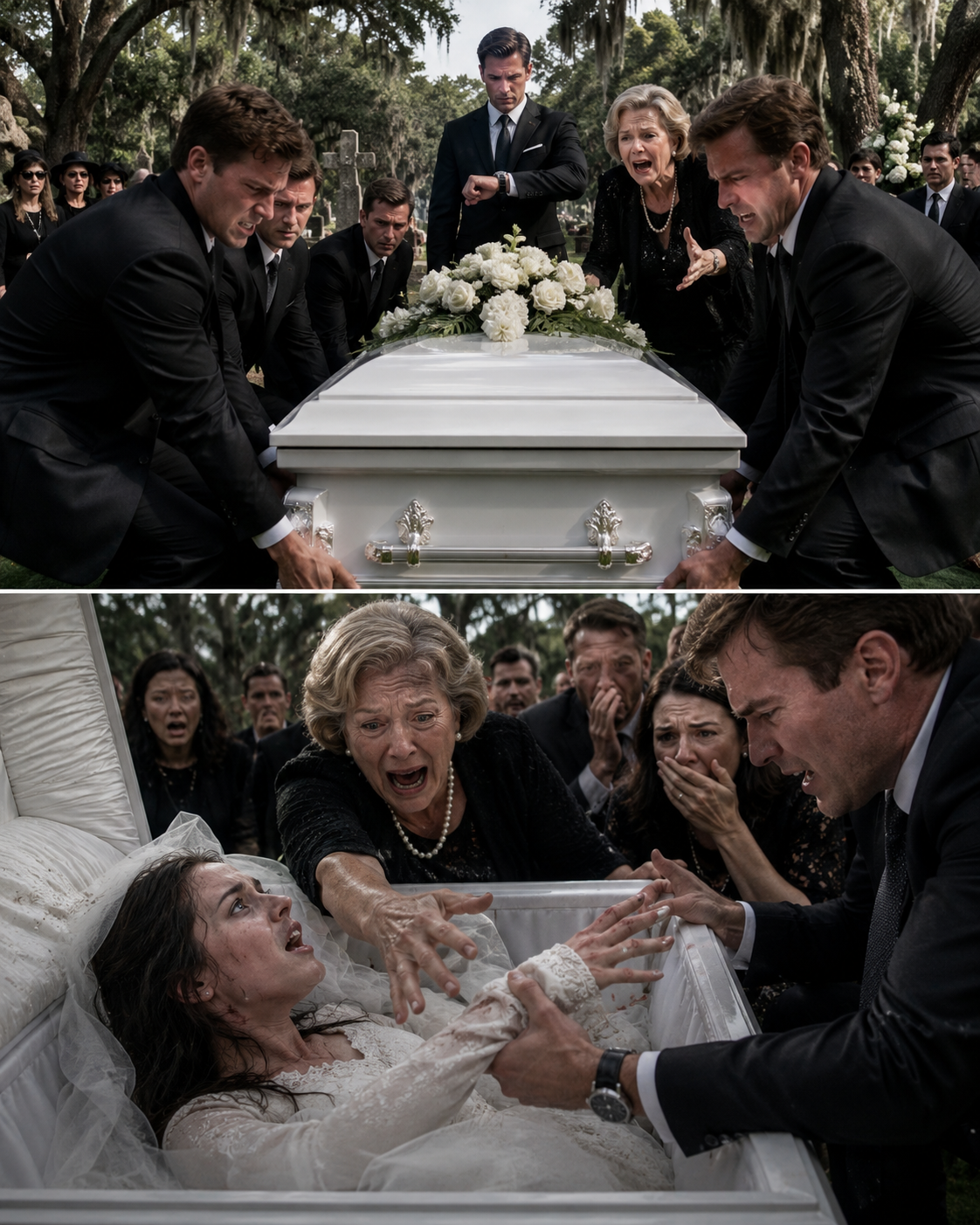
Margaret stood beneath the oaks while Spanish moss shifted in the humid air. She thought about the coffin that would not move. People still argued over it. Some said divine justice. Some said shock and uneven ground. Amos said he had felt something holding the handles down, though he could never explain it.
Margaret no longer needed an explanation.
A coffin had refused to become a lie.
That was enough.
She placed the funeral ribbon on the ground. The one that had read Beloved Wife. Forever Cherished. She had kept it all this time, not as a memorial, but as evidence of how pretty lies could look when printed in gold.
Then she struck a match.
The ribbon curled and blackened.
Behind her, footsteps approached.
Hannah came slowly along the path, Mercy strapped to her chest in a soft carrier, Teresa walking beside her. Hannah stopped a few feet away.
“I thought I’d find you here,” she said.
Margaret wiped her eyes quickly. “I needed to burn something.”
Teresa looked at the ash. “Good choice.”
For the first time, all three women laughed.
It was not a big laugh. It did not erase anything. But it existed, and that made it precious.
Hannah looked at the empty patch of grass.
“I used to dream about this place,” she said. “When I first came home from the hospital, every time I closed my eyes, I was back in that box. I could smell the satin. I could hear my own breathing getting smaller. I kept thinking, what if nobody hears me?”
Margaret’s voice trembled. “I should have heard you sooner.”
“Yes,” Hannah said.
The honesty hurt, but it also steadied them.
Hannah touched Mercy’s back. “But you heard me when it mattered.”
Margaret shook her head. “You made yourself heard.”
“I know.”
They stood together in silence.
Then Teresa said, “There’s a church picnic starting in Forsyth Park. Hannah wants Mercy to see normal people doing normal things.”
Hannah smiled faintly. “I want Mercy to grow up around sunlight.”
Margaret looked at the baby. Mercy was awake now, blinking at the trees with solemn curiosity. The crescent birthmark behind her ear showed like a tiny moon.
“May I come?” Margaret asked.
Hannah studied her.
Their relationship had no simple name anymore. Mother-in-law was too small. Mother was not hers to claim. Friend was too easy. They were bound by injury, choice, guilt, truth, and a child who would one day ask hard questions.
Finally, Hannah nodded.
“Yes,” she said. “But when people ask, we tell it right.”
Margaret held her gaze. “Every time.”
They left the cemetery together.
Savannah looked different that afternoon. The same old homes stood behind their iron fences. The same tourists moved through the squares. The same church bells rang over streets polished by history and haunted by everything history tried to hide.
But Hannah no longer moved like a ghost inside someone else’s story.
At Forsyth Park, under the wide green canopy, Mercy began to fuss. Hannah lifted her from the carrier and kissed her cheek.
Margaret watched Hannah’s hands. The nails had grown back, not perfectly, but strong enough. They would always carry faint ridges where the damage had been deepest.
Proof, Margaret thought, that healing was not the same as returning untouched.
A little girl from a nearby picnic blanket ran over and peered at the baby.
“What’s her name?” the child asked.
Hannah smiled.
“Mercy.”
The little girl tilted her head. “Like when somebody forgives you?”
Hannah looked at Margaret, then at Teresa, then down at her daughter.
“Not exactly,” she said gently. “Like when someone is trapped in the dark, and the world finally opens the door.”
Margaret felt tears rise again, but this time she did not hide them.
Mercy waved one tiny fist in the sunlight as if agreeing with her mother.
And somewhere beyond the park, beyond the courthouse, beyond the cemetery where a coffin had once refused to move, the city kept breathing.
So did Hannah.
So did her daughter.
And when Mercy grew old enough to ask why her grandmother Margaret always cried at church bells, why her grandmother Teresa hated sealed doors, and why her mother kept a bloodstained note locked in a small wooden box, Hannah would tell her the truth.
Not that she had died.
Not that a miracle had saved her.
But that she had been betrayed, buried, and almost erased.
That she knocked anyway.
That somebody listened.
And that was how Mercy learned the first law of her life before she could even speak: love is not proven by what people say over your coffin, but by who tears the lid open while you are still fighting inside.
THE END