Part 2:
The yellow flower—a delicate, impossible bloom against the freezing Parisian backdrop—sat securely in Clara’s gloved hand. She hadn’t let go of it since the dog, whose name she didn’t yet know, had gently placed it at her boots. She sat on the edge of her bed in her small, drafty apartment, the small radiator clanking noisily in the corner, offering a stark contrast to the profound stillness that had settled over her. The flower wasn’t just unusual; it was an anomaly. It wasn’t a weed or a common wildflower. It looked almost tropical, its petals thick and slightly waxy, holding a faint, sweet fragrance that defied the biting cold it had somehow survived.
How could a homeless man, or his dog, have found such a thing in the dead of winter? It wasn’t the sort of flower sold in the corner florists, and certainly not something found growing through the cracks of the cobblestones. The mystery of it tugged at her, stronger even than the urge to simply warm up and forget the harsh realities of the streets she walked every day.
The next morning, Clara deliberately altered her route to work. The wind was less severe, but the cold remained an oppressive force. She found herself scanning the doorways and alleyways, looking for the familiar shape of the old man and his scruffy companion. Her heart sank slightly when she reached the spot where she had left them yesterday. The spot was empty. No cardboard, no man, no dog. Only the faint outline of where the snow had melted slightly beneath the heavy plaid blanket remained.
She hesitated, a feeling of unease settling over her. Had he moved on? Or worse, had the cold finally claimed him?
Clara continued to the small bakery where she worked, the yellow flower carefully preserved between the pages of a heavy book in her bag. The day passed in a blur of flour and the comforting smell of baking bread, but her mind constantly drifted back to the man—Henri, she later learned from a regular customer who recognized her description of him.
“Old Henri?” Monsieur Dubois had said, shaking his head. “He’s been around for years. A quiet sort. Rarely speaks. Some say he used to be someone important, before… well, before whatever happened, happened. It’s a tragedy, really. But he keeps to himself, him and that mutt of his.”
“Important?” Clara had asked, wiping flour from her apron. “Important how?”
Monsieur Dubois had shrugged, a typically dismissive Parisian gesture. “Who knows? Rumors. Something about the art world, or perhaps antiques. No one really knows the truth. He’s just another ghost on the streets now.”
That evening, the mystery deepening, Clara couldn’t resist going back. She waited until her shift ended, pulling her coat tight, and headed back toward the bridge where she had first seen him. She walked the surrounding streets for an hour, the cold biting through her boots, before she finally saw a familiar shape huddled in an alleyway, partially obscured by discarded crates.
It was Henri. And the dog was curled beside him, sleeping fitfully. The plaid blanket she had given him was gone.
Clara approached slowly, not wanting to startle him. “Henri?” she called softly.
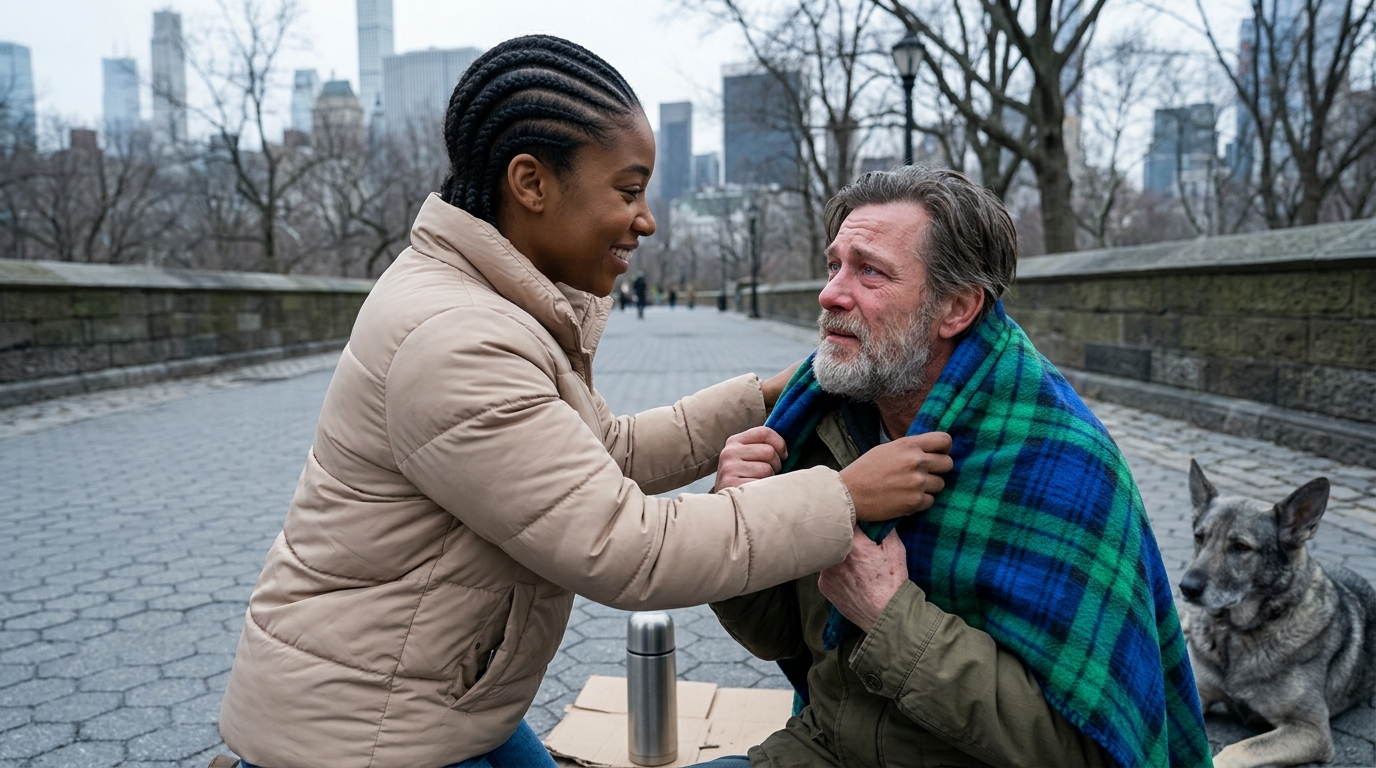
The old man stirred, coughing a deep, rattling cough before looking up. His eyes, though still clouded with hardship, sparked with a faint glimmer of recognition. He offered a weak nod.
“Where is your blanket?” she asked, a surge of protective anger flaring within her. Had someone stolen it from him?
Henri shook his head slowly, his voice little more than a dry rasp. “Not for me. Too… conspicuous.”
Clara frowned, not understanding. “Conspicuous? But you need to stay warm.”
He looked away, his gaze fixing on a point somewhere in the distance. “They notice. They see the new things. It brings trouble.”
Clara crouched down beside him, her heart aching. “Who notices? Who brings trouble?”
Henri remained silent for a long moment, the only sound the wind whistling through the alley. When he finally spoke, his words sent a chill down her spine that had nothing to do with the weather.
“The ones looking for what I lost,” he whispered, his voice trembling slightly.
Before Clara could press him further, the dog suddenly sat up, its ears pricked forward, a low growl rumbling in its chest. It wasn’t looking at Clara; it was staring intently down the alleyway, into the gathering shadows.
Clara turned, following the dog’s gaze. The alley was poorly lit, the shadows long and deceptive. At first, she saw nothing. But then, a figure separated from the gloom—a tall silhouette, standing perfectly still, watching them.
A sudden, sharp fear seized her. This wasn’t a casual passerby. There was a predatory stillness to the figure, a silent menace that hung in the air. The dog’s growl deepened, transforming into a warning bark.
“You should go, miss,” Henri said, his voice suddenly urgent, grabbing her sleeve with surprisingly strong, bony fingers. “Now. Forget you saw me. Forget the flower.”
The flower. The impossible yellow flower.
“Who are they?” Clara demanded, her voice rising despite herself. “What do they want?”
“Everything,” Henri replied simply, the single word carrying the weight of a devastating truth.
Clara stood up, her heart pounding a frantic rhythm against her ribs. The figure in the shadows hadn’t moved, but the feeling of being watched was overwhelming. She looked down at Henri, then back at the dog, who stood defensively in front of its master.
“I won’t just leave you,” she said, though her voice shook slightly.
“You must,” Henri insisted, his eyes filled with a desperate plea. “If you stay, you become part of the debt. And the debt is blood.”
The stark words hung in the freezing air, chilling her more than the Parisian winter ever could. Clara backed away slowly, her eyes darting between the huddled man and the silent watcher in the shadows. The mystery of the yellow flower had suddenly transformed from a curiosity into something dangerous—something that involved stolen blankets, hidden pasts, and a debt paid in blood.
As she finally turned and hurried out of the alley, the image of Henri, frail and terrified, burned in her mind. The yellow flower in her bag felt suddenly heavy, no longer a token of gratitude, but a key. A key to a locked door she had inadvertently stumbled upon, and behind that door, she realized with a growing sense of dread, lay secrets that someone was willing to kill for.
The streets of Paris, once familiar and beautiful, now felt like a labyrinth of unseen dangers. The story wasn’t just unfinished; it had barely begun.