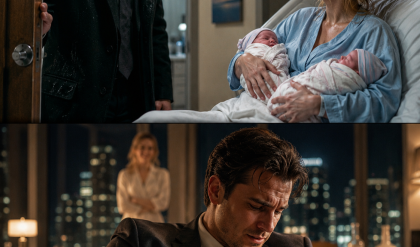
Because she wanted to remember how small the world looked when someone else was holding the door shut.
At 1:15, Briana was wiping the glass coffee table in the lobby when she heard Mandarin again.
A younger member of Victor Liang’s delegation sat on a sofa, phone pressed to his ear, voice tense.
“The interpreter is a problem,” he said in Mandarin. “He keeps softening Mr. Liang’s words. He is turning objections into preferences. If this continues, Mr. Liang will walk away.”
Briana’s cloth slowed against the glass.
So it was not just her.
The Chinese team knew something was wrong too.
Another delegate approached and asked the younger man where the restroom was.
Briana pointed down the corridor and answered automatically in Mandarin.
“Down the hall, second door on your left.”
Four seconds.
That was all.
The two men froze.
The younger delegate lowered his phone.
He looked at her uniform. Then the spray bottle in her hand. Then her face.
“You speak Mandarin?” he asked.
Briana gave a polite nod.
“A little.”
His eyes narrowed slightly, not in suspicion, but in sudden interest.
“That was not a little.”
Briana almost smiled.
Then she saw Vanessa across the lobby.
And the smile died before it was born.
Part 2
Vanessa crossed the lobby like a storm in designer heels.
“What do you think you’re doing?”
Briana turned, cloth still in hand.
“They asked me a question, ma’am.”
“They asked you?”
Vanessa laughed once, sharp and ugly.
“Do you think because you memorized a few tourist phrases from the internet, you can walk up to our most important clients and start chatting?”
The younger Chinese delegate stiffened, clearly understanding that something hostile was happening even if he did not catch every word.
Briana kept her voice low.
“I only gave directions.”
“You clean rooms,” Vanessa said. “That is what you do. That is all you do.”
The words landed in the lobby with humiliating force.
A guest at the bar looked over.
One of the bellmen shifted uncomfortably.
Vanessa stepped closer and smiled the kind of smile that had no warmth in it.
“If I see you near a VIP guest again, I will make sure you never work in this city’s hospitality industry again. Do you understand me?”
Briana’s throat tightened.
“Yes, ma’am.”
“Good.”
Vanessa turned and walked away, already smoothing her blazer, already becoming professional again for people she considered worth impressing.
Briana took her cart into the service elevator.
When the doors closed, she leaned against the metal wall.
Her hands shook.
She looked at the bracelet.
Language is the one thing nobody can repossess.
She tried to whisper it.
Her voice cracked halfway through.
On the fourteenth floor, she entered a guest suite to turn down the bed. A handwritten note sat on the desk beside a room service tray.
It was in French.
The guest requested extra pillows without synthetic fill because of severe allergies.
Briana read it instantly, wrote a warm reply in elegant French, signed only her employee number, and arranged the hypoallergenic pillows on the bed.
Ninety seconds.
No drama.
No announcement.
But someone saw.
Diane Prescott, front desk supervisor, had worked at the Whitmore for twenty-three years. She knew which guest liked sparkling water, which elevator stuck in winter, which executive lied when he smiled, and which housekeepers quietly held the entire building together.
She passed suite 1408 just as Briana was writing in French.
Diane stopped in the doorway.
She watched Briana finish the note, place it neatly on the pillows, and leave.
Briana never noticed.
But Diane did.
Downstairs, the crisis worsened.
At 1:35, Gerald Crawford sat in his office, flipping through briefing documents with a cold coffee beside his laptop.
Gerald was not flashy. He did not come from money. He did not talk unless he had something worth saying. His staff respected him because he remembered names, handled pressure without screaming, and once personally drove a sick dishwasher to urgent care when the hotel nurse was unavailable.
Still, even good managers miss what their systems teach them not to see.
He had noticed something strange that morning.
The interpreter’s summaries did not match the tone of Victor Liang’s body language. The words sounded mild, but Victor’s face looked like a man being insulted.
Gerald marked the concern in his notes, then moved on. The meeting was minutes away, and ten fires were burning at once.
He should have stopped there.
He didn’t.
At 1:40, Briana entered the business center to empty trash bins.
Her eyes were still red.
On the printer tray lay a stack of forgotten pages from the legal team.
She saw the header first.
Acquisition Governance Term Sheet.
She should not have read it.
She read it.
In under two minutes, she found the clause.
In English, the phrase was collaborative oversight with shared decision-making authority during transition.
A partnership.
But the phrase she had heard interpreted into Mandarin implied operational transfer and final authority ceded to the hotel group.
A surrender.
Two sides were sitting at the same table believing in two different deals.
Victor Liang was not difficult.
He was not arrogant.
He was being asked, in his language, to give up control of a billion-dollar investment.
Briana put the papers back exactly where she found them.
Her heart hammered.
She could tell someone.
But who?
Vanessa had just threatened to destroy her career. The front desk staff had watched and said nothing. The executives upstairs would not believe a housekeeper over a certified interpreter in a tailored suit.
She walked to the break room and sat alone.
Her notebook was open to page 34.
This role requires a professional communication background.
On the blank page beside it, Briana wrote three words.
Maybe she’s right.
She stared at them until they blurred.
Then Diane Prescott appeared in the doorway.
“The guest in 1408 called,” Diane said.
Briana looked up quickly, worried she had done something wrong.
“He wanted to know who wrote the note in French. Said it was the most considerate service he’d received in years. He asked for your name.”
Briana did not know what to do with that.
No guest had ever asked for her name.
Diane sat across from her.
“How many languages do you speak, Briana?”
Briana’s fingers closed over the notebook.
For years, she had hidden it out of instinct. Not because she was ashamed of learning, but because every dream felt safer when no one else could mock it.
But Diane’s voice was different.
It did not order.
It asked.
So Briana told her.
Not everything at first. Then more. Then all of it.
The mistranslation. The governance clause. The investor’s real concern. The call in the lobby. The young delegate. The possibility that the entire deal was collapsing over language everyone else was too proud to question.
Diane listened without interrupting.
When Briana finished, Diane was very still.
“You need to tell Gerald.”
Briana shook her head.
“Ms. Holt told me if I go near them again, I’m done.”
Diane leaned forward.
“Vanessa Holt can threaten your job. She cannot decide your worth.”
Briana gave a small, tired laugh.
“With respect, Ms. Prescott, people like her decide both every day.”
Diane’s face softened.
“I know.”
For a moment, neither woman spoke.
The break room refrigerator hummed. Someone’s forgotten coffee turned cold in the corner. From far away came the faint ding of an elevator.
Diane looked down at the notebook and saw the fresh words.
Maybe she’s right.
Her eyes hardened.
“I have worked in this hotel for twenty-three years,” Diane said. “I have watched brilliant people stay invisible because someone with a title found it convenient. I have watched fools get promoted because they knew how to sound expensive. I am telling you Gerald Crawford will listen if the information is real.”
Briana’s eyes stung.
“What if I’m wrong?”
“Then you will be wrong trying to help.” Diane’s voice became quiet iron. “But if you are right and you stay silent, you will remember this day every time someone tells you to know your place.”
Briana looked at page 34.
The rejection letter.
Then the words she had just written.
Maybe she’s right.
She picked up her pen and drew a hard line through the sentence.
Not erased.
Crossed out.
Then she closed the notebook.
“What floor is Mr. Crawford’s office?”
Diane smiled.
“Third. Turn left. And I’m coming with you.”
Ten minutes before the formal meeting, Gerald Crawford’s assistant stood from his desk as Diane and Briana approached.
“He’s preparing for the two o’clock. No walk-ins.”
Diane did not move.
“She has critical information about the Liang deal.”
The assistant looked from Diane to Briana.
The wrinkled uniform. The service shoes. The spray bottle still clipped to her apron.
He hesitated.
Diane lifted her chin.
“I have been here twenty-three years. I am vouching for her personally.”
Twenty-three years carried weight.
The assistant stepped aside.
Briana entered Gerald’s office alone.
Gerald looked up.
He did not ask why housekeeping was in his office.
He did not call security.
He set down his pen.
“What do you need me to know?”
That almost broke her.
Not because it was kind.
Because it was the first useful question anyone with power had asked her all day.
Briana spoke quickly.
Clear. Structured. Precise.
She explained the mistranslation and the clause. She told him the Chinese side believed the contract demanded total surrender of post-acquisition authority. She explained that Victor Liang’s anger was not cultural stubbornness but a rational response to distorted language.
Gerald listened.
Then he turned his laptop toward her.
“Read this.”
On the screen was a paragraph from the Mandarin version of a supplemental memo.
Briana translated it live.
No hesitation.
Not word by word like a machine.
Meaning by meaning, with legal nuance intact.
Gerald’s face changed.
He leaned back slowly.
“How did you learn this?”
“A public library,” Briana said. “And a grandmother who believed cleaning offices was not the same thing as being small.”
Gerald stared at her for one second longer than comfortable.
Then he picked up his phone.
“Deactivate the interpreter’s access for the two o’clock meeting,” he said. “Now.”
He hung up and stood.
“I need to ask you something, Ms. Davis.”
Ms. Davis.
Not Briana.
Not housekeeping.
Ms. Davis.
“If I bring you into that room, and you are wrong, this hotel may lose a billion-dollar deal. If you misspeak, if you misunderstand, if the negotiation collapses because of your translation, that weight will land on your name. Are you prepared to carry that?”
The office went quiet.
Briana thought of Loretta counting coins at the kitchen table.
She thought of the library card.
She thought of Vanessa’s face when she said, You clean rooms.
She thought of page 34.
Then she looked Gerald Crawford in the eyes.
“Yes.”
One word.
No apology.
Gerald nodded once.
“Good. If you had said anything else, I would not have believed you were ready.”
He opened the office door.
Diane stood outside, hands clasped tightly.
Gerald gave her a brief nod.
“Thank you.”
Diane’s eyes flickered toward Briana.
Twenty-three years of being overlooked had brought her to one moment where looking mattered.
Gerald walked beside Briana down the long corridor to the grand boardroom.
Not ahead of her.
Beside her.
His polished leather shoes clicked against the marble.
Her repaired sneakers squeaked softly.
Click.
Squeak.
Click.
Squeak.
Two lives.
One hallway.
As they walked, Gerald said without looking at her, “My mother cleaned rooms in a hotel in Scranton for twenty-two years.”
Briana turned slightly.
“She knew everything about everyone,” Gerald said. “Guests’ allergies. Their kids’ names. Which businessmen were kind when no one important was watching. Which ones weren’t. She used to say the people who clean the room know the room best.”
Briana touched her bracelet.
“My grandmother said almost the same thing.”
Gerald stopped at the double doors.
Through the frosted glass, silhouettes moved around the long table.
The air itself seemed tense.
“Ready?” he asked.
Briana looked at the doors.
Then at her shoes.
Then at the bracelet.
“Yes.”
Part 3
When Gerald opened the boardroom doors, every head turned.
The room was built to intimidate.
Mahogany table. Floor-to-ceiling windows. Crystal water glasses untouched in perfect rows. Chicago’s skyline spread behind the glass like money made visible.
On one side sat the Whitmore executives.
Vanessa Holt was near the center, back straight, jaw tight.
On the other side sat Victor Liang’s delegation.
Victor himself stood at the far end of the table with his briefcase open.
He was already packing.
Vanessa shot to her feet.
“Gerald, what is this?”
Her eyes landed on Briana.
Her face flushed with fury.
“She is housekeeping. I specifically told her—”
Gerald did not raise his voice.
“Vanessa, sit down or leave the room.”
The silence that followed was so complete even the air-conditioning seemed to pause.
Vanessa looked around for support.
No one gave it.
Slowly, she sat.
Victor Liang spoke first in Mandarin, fast and controlled, anger wrapped in formality.
Briana listened.
Every word.
Every wound beneath every word.
He said his concerns had been minimized. He said his team had been given explanations that contradicted the documents. He said he could not invest in a partnership where clarity had to be fought for and respect had to be requested.
Then he said, “We are leaving. It is over.”
He reached into the briefcase.
Briana stepped forward.
She did not ask permission.
She did not look at Vanessa.
She did not look at Gerald.
She looked directly at Victor Liang and spoke in Mandarin.
“Mr. Liang, before you leave, I would like to repeat what you have said today so you know at least one person in this building heard you correctly.”
Victor’s hand stopped.
Briana continued.
She repeated his concerns back to him.
Not polished.
Not softened.
Not filtered through hotel-friendly language.
She spoke his meaning with exact precision: authority, governance, operational control, transition oversight, trust, respect.
The room did not understand the words, but it understood the change.
Victor slowly removed his hand from the briefcase.
Briana then turned slightly toward Gerald and translated for the English-speaking side.
“Mr. Liang is not objecting to the timeline. He is objecting to the authority structure as it has been communicated to him. He believes the interpreted language means Liang Global would surrender final operational authority while still carrying the financial risk.”
Gerald’s face tightened.
The ownership representative, Philip Ellsworth, leaned forward for the first time all day.
Briana turned back to Victor.
“In the English term sheet,” she said in Mandarin, “the phrase is collaborative oversight with shared decision-making authority. It describes a partnership during transition. But what you have been hearing in Mandarin implies full transfer of authority. Those are not the same agreement.”
Victor stared at her.
Briana’s voice remained calm.
Then she said the sentence that changed the room.
“You were not being deceived. You were being mistranslated. Those are very different things.”
Victor Liang closed his briefcase.
The sound was quiet.
It landed like thunder.
He sat down.
Across the table, executives exhaled without realizing they had been holding their breath.
Vanessa looked as if all the blood had left her body.
Victor studied Briana for a long moment.
Not her uniform.
Not her cart.
Not the old shoes.
Her.
“Who taught you to speak like this?” he asked.
Briana answered in Mandarin.
“A public library and a woman who cleaned offices for thirty years.”
Victor’s expression shifted.
Respect, when it arrives honestly, does not always look dramatic. Sometimes it is simply a powerful man lowering his guard because the person in front of him has earned the truth.
He reached for his water glass.
It was the first glass touched in the room all day.
He drank, set it down, and said one word.
“Continue.”
So she did.
For the next forty-five minutes, Briana Davis became the bridge everyone else had failed to build.
When Gerald spoke, she translated not only his words but his intent.
When Victor used a proverb, she did not flatten it into nonsense. She found the nearest English equivalent and carried the emotional weight across the table.
When the hotel’s legal counsel used aggressive phrasing that would have sounded insulting in Mandarin, Briana paused.
“With respect,” she said, “that wording will create the same problem again. May I suggest a clearer formulation?”
Everyone looked at Gerald.
Gerald looked at Briana.
“Please do.”
And she did.
By the end of the hour, the room felt different.
The water glasses were no longer untouched. Pens moved. Shoulders lowered. The Chinese delegates began speaking among themselves in tones that sounded like problem-solving instead of departure.
Victor finally raised a hand.
“I want to speak privately with Mr. Crawford,” he said.
The room emptied.
Vanessa left without looking at anyone.
Briana moved toward the door too.
Victor stopped her.
“Not you.”
She turned.
“You stay.”
Only three people remained: Victor Liang, Gerald Crawford, and Briana Davis.
Victor spoke slowly now.
The deal would move forward.
The terms would be revised with correct bilingual language.
His team would remain in Chicago through the week.
But he had one condition.
He looked at Briana, not Gerald.
“She is the liaison,” he said. “All communication between my team and yours goes through her. No exceptions.”
Gerald did not hesitate.
“Agreed.”
Victor leaned back.
“I do not trust buildings,” he said. “I do not trust titles. I trust people. Today, she was the only person in this room who spoke to me without a mask.”
Briana translated the words, but her voice shook slightly near the end.
Gerald turned to her and extended his hand.
Not like a boss congratulating staff.
Like one professional acknowledging another.
Briana shook it.
Her grandmother’s bracelet caught the afternoon light.
When the boardroom doors opened, the hallway outside was crowded.
Word had spread.
Front desk staff. Bellmen. Catering workers. Junior executives. Housekeepers pretending to pass through with towels they did not need to deliver.
Diane Prescott stood at the edge of the crowd, hands pressed together, eyes bright.
Gerald stepped forward.
“I want this on record,” he said. “Today’s deal was saved by Briana Davis, an employee our system nearly overlooked. That failure belongs to the system, not to her.”
No one moved.
Then Victor Liang stepped beside Briana.
In front of every executive, every clerk, every person who had seen Vanessa humiliate her and said nothing, he lowered his head in a small, deliberate bow.
A gesture of respect.
Quiet.
Unmistakable.
Briana bowed her head in return.
Philip Ellsworth, the ownership representative, crossed the hallway and placed his card in her hand.
“Call me Monday,” he said.
The young delegate from the lobby smiled.
“I knew,” he said in Mandarin. “The second you spoke by the coffee table, I knew.”
Briana laughed softly, almost in disbelief.
From the back of the crowd, a bellman named Raymond Tucker stared at the floor, shame written all over his face. He had watched Vanessa humiliate her. He had said nothing.
Their eyes met.
He mouthed, “I’m sorry.”
Briana gave the smallest nod.
Not forgiveness exactly.
But an opening.
Across the lobby, the French guest from suite 1408 was checking out with his suitcase. He knew nothing about billion-dollar deals or governance clauses or boardroom humiliation.
He only saw Briana standing among people in suits.
He raised his hand and smiled.
Briana smiled back.
Sometimes dignity returns in pieces.
A bow.
A business card.
A wave from a stranger who remembered kindness.
Two weeks later, Vanessa Holt was no longer director of guest relations.
There was no dramatic public firing. No shouting match. No security escort through the lobby.
Real justice often moves quietly.
The official memo said she had been reassigned due to conduct detrimental to workplace culture and obstruction of operational processes.
Everyone knew what it meant.
She had nearly destroyed a billion-dollar deal, not because the hotel lacked resources, but because she could not imagine that the person capable of saving it might be wearing a housekeeping uniform.
Diane Prescott was promoted to director of guest relations.
At the announcement, she stood in front of the staff, overwhelmed and trying not to cry.
“I didn’t discover Briana,” Diane said. “I was just the first person who didn’t look away.”
Briana was given an office on the third floor.
Small, but with a window.
On the door was a brass nameplate:
Briana Davis
Cultural and Linguistic Liaison
During Vanessa’s final week in the main building, she had to pass that office every morning on the way to the parking garage.
Every morning, the nameplate was there.
Eye level.
Impossible to avoid.
On Vanessa’s last day, she carried a cardboard box down the hallway. Briana was walking from the opposite direction.
They stopped face to face.
No audience.
No marble-lobby performance.
Just two women in a quiet corridor.
Briana spoke first.
“I wish you all the best, Ms. Holt.”
No sarcasm.
No victory lap.
Vanessa said nothing.
She adjusted the box in her arms and walked away.
Her heels clicked against the marble.
Fast at first.
Then softer.
Then gone.
Briana did not need Vanessa destroyed in order to rise.
But sometimes justice is simply this: the person who tried to make you invisible being forced to read your name on the door.
That evening, Briana sat alone in her new office.
The city glowed beyond the window. Traffic moved below like ribbons of red and white light. Somewhere upstairs, housekeepers were still turning down beds. Somewhere downstairs, guests were still asking questions of people they barely saw.
Briana opened her old notebook.
Page 34.
The rejection email.
This role requires a professional communication background.
She unfolded it carefully and placed it in a simple frame.
Then she turned to the next page.
Maybe she’s right.
The words were still there, crossed out by one hard line.
She tore out neither page.
She framed them both.
Not out of bitterness.
Out of memory.
Because the greatest danger is not being underestimated.
It is believing the people who underestimate you.
Six months later, the Whitmore Hotel Group paid for Briana to complete a professional certification in international business mediation.
Victor Liang invited her to Shanghai to work directly with his transition team for three months.
It was the first time Briana Davis had ever been on an airplane.
Think about that.
A woman who had taught herself four languages from library books, podcasts, borrowed DVDs, and a cracked phone screen had learned to speak to the world before the world ever gave her a chance to see it.
Now she was seeing it.
Shanghai at night.
Boardrooms where people waited for her to speak.
Contracts that did not move until she had reviewed the language.
Men with fortunes listening carefully because she had earned the one thing money cannot buy.
Trust.
Philip Ellsworth introduced her to multinational companies looking for cultural liaison specialists.
Within a month, Briana received three job offers.
Big salaries.
Big titles.
Big offices.
She turned them down.
Not because she lacked gratitude.
Because she was finished waiting for someone else to decide which room she belonged in.
A year after the day Victor Liang almost walked out, Briana launched her own firm.
Loretta Davis Cultural Consulting.
The logo was simple: a small green bracelet forming a circle around an open door.
Her first major client was the Whitmore Hotel Group.
Her second was a manufacturing company negotiating in Brazil.
Her third was a hospital network expanding partnerships in North Africa.
She hired translators with degrees.
She also hired a night janitor who spoke fluent Korean, a former bus driver who knew three dialects of Arabic, and a grocery cashier who had been quietly translating immigration paperwork for neighbors for ten years without pay.
Briana’s rule was simple.
Credentials matter.
But curiosity matters too.
Ask people what they carry before deciding what they lack.
With her first profits, she funded a free language program at the same public library where she had once sat alone under fluorescent lights.
She named it The Loretta Program.
On opening night, Diane Prescott attended.
So did Gerald Crawford.
So did Victor Liang, who sent flowers and a handwritten note in Mandarin.
Briana stood at the front of the room, looking out at teenagers, retirees, immigrants, hotel workers, single mothers, security guards, and children sitting cross-legged on the floor.
She touched the bracelet on her wrist.
“My grandmother used to say language is the one thing nobody can repossess,” Briana said. “I used to think that meant words. Now I know it means dignity. It means access. It means being able to walk into a room that was not built for you and still tell the truth.”
She paused.
In the back row, a young hotel housekeeper in a navy uniform wiped her eyes.
Briana saw her.
Really saw her.
And smiled.
“So if you came here because someone told you that you were too old, too poor, too busy, too invisible, or too late, let me tell you what my grandmother would have told you.”
The room went still.
Briana lifted her chin.
“Start anyway.”
Years later, people would still tell the story of the day a Chinese investor walked out of a billion-dollar hotel deal until a maid opened her mouth and saved it all.
Some told it like a miracle.
It was not a miracle.
It was years of study no one saw.
It was a grandmother’s wisdom.
It was a woman at a front desk choosing not to look away.
It was a manager willing to listen.
It was one person, in one impossible moment, refusing to believe that her uniform was the limit of her value.
And if there is one thing worth remembering, it is this:
The room did not give Briana Davis power.
It finally stopped blocking the door.
THE END